 By:
Marilyn Schenk
By:
Marilyn Schenk 
According to Mordor Intelligence, the game-based learning market size is expected to increase from USD 29.46 billion in 2025 to USD 34.90 billion in 2026, and to USD 80.22 billion by 2031, growing at a CAGR of 18.11% from 2026 to 31.
The education sector is evolving rapidly, as the above-mentioned data reflects this transformation clearly. This all happens with the emergence of learning gamification platform like Kahoot, Cisco, and Duolingo.
The traditional methods of learning have faded and are filled with zero excitement, which makes learning ineffective. Generations are changing, and expecting them to learn from the decades-old learning pattern won’t be justified, as it doesn’t hold any relevance in the current situation.
Therefore, a tech-driven transition is taking place, gradually.
In this blog, we’ll delve deeper into gamified learning solutions and their pros, cons, and implementation tips.
Gamified learning solutions are training programs that incorporate game tactics to educate, for instance, points, badges, leaderboards, challenges, and rewards into education. It levels up pencil and book approaches.
Unlike full game-based learning solutions, gamification enhances existing lessons that improve knowledge retention, learner participation, performance tracking, and overall training effectiveness across academic environments.
There are multiple reasons why gamified e-learning solutions are gaining momentum in 2026, though the relevancy remains at the top of the arch. In the current economy, traditional learning has become ineffective.
Though the gamified learning services solve this problem through their use of points, challenges, and progress tracking. It motivates learners to participate actively rather than passively watch content.
Below, look at familiarised gamified e-learning solutions and how they’re gaining momentum
1. Attention Economy & Shrinking Focus Spans
Students with traditional learning face continuous digital interruption. This prevents them from maintaining concentration during traditional education methods. A learning gamification platform widely uses rewards, levels, challenges, and instant feedback to maintain engagement.
This interactive learning experience helps students to develop better focus and increase their participation while they retain more knowledge.
2. Rise of Remote and Hybrid Work Models
The digital training solutions need to become scalable as distributed teams have become standard in organisations. A learning gamification platform enables anytime, anywhere access, while users can work together through leaderboards, team challenges, and shared goals. This helps to sustain their motivation in remote work situations.
3. Growing Gen Z Workforce Expectations
The Gen Z professionals prefer interactive, mobile-first, and visually engaging learning formats. Students who use digital technology for their learning will benefit from gamified learning. This provides them with interactive content that moves beyond traditional educational materials. The training program establishes a connection with modern employees through its engaging content that meets their current work requirements.
4. Increasing Demand for Experiential Learning
The organisation has started to prefer active learning methods that require people to learn through practical experience instead of traditional approaches. Learners use gamified modules to develop their decision-making skills through the practice of real-life situation wishing safe learning environment.
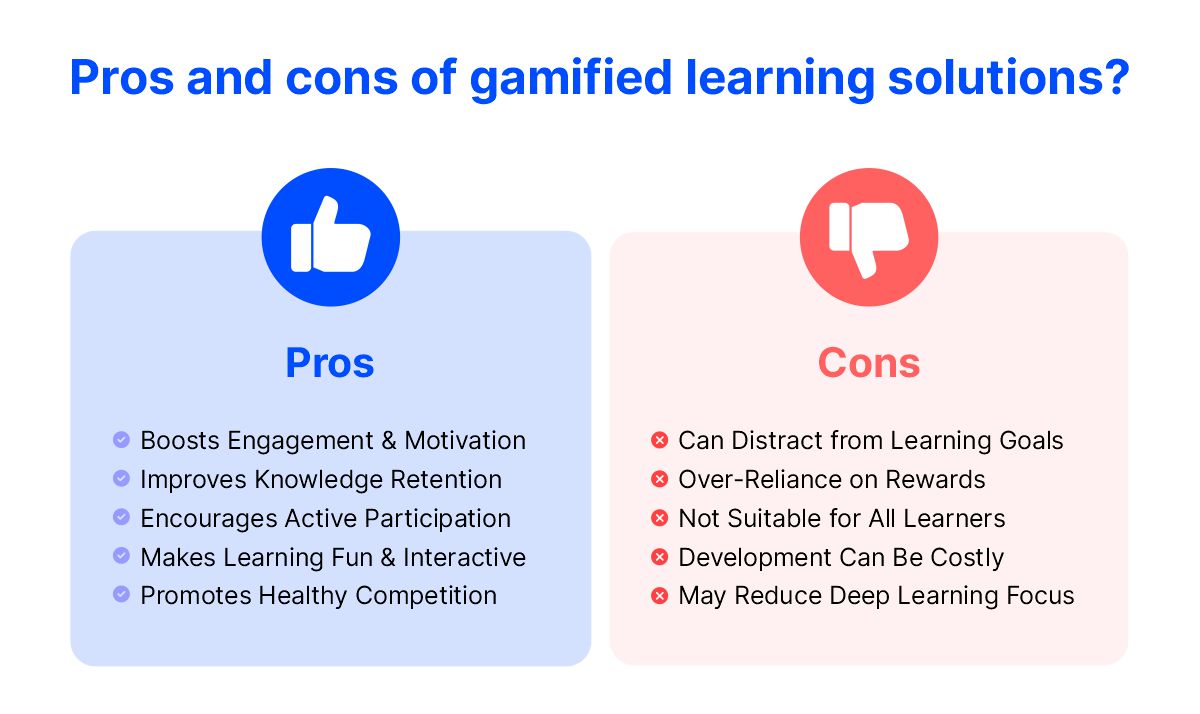
The gamified learning solutions are transforming how organisations and educatonala institution provide their training programmes. The interactive game mechanics of these solutions create immersive learning experiences. This includes embedded learning objectives.
The following essential benefits of the system have become the main reasons why organisations select to implement it.
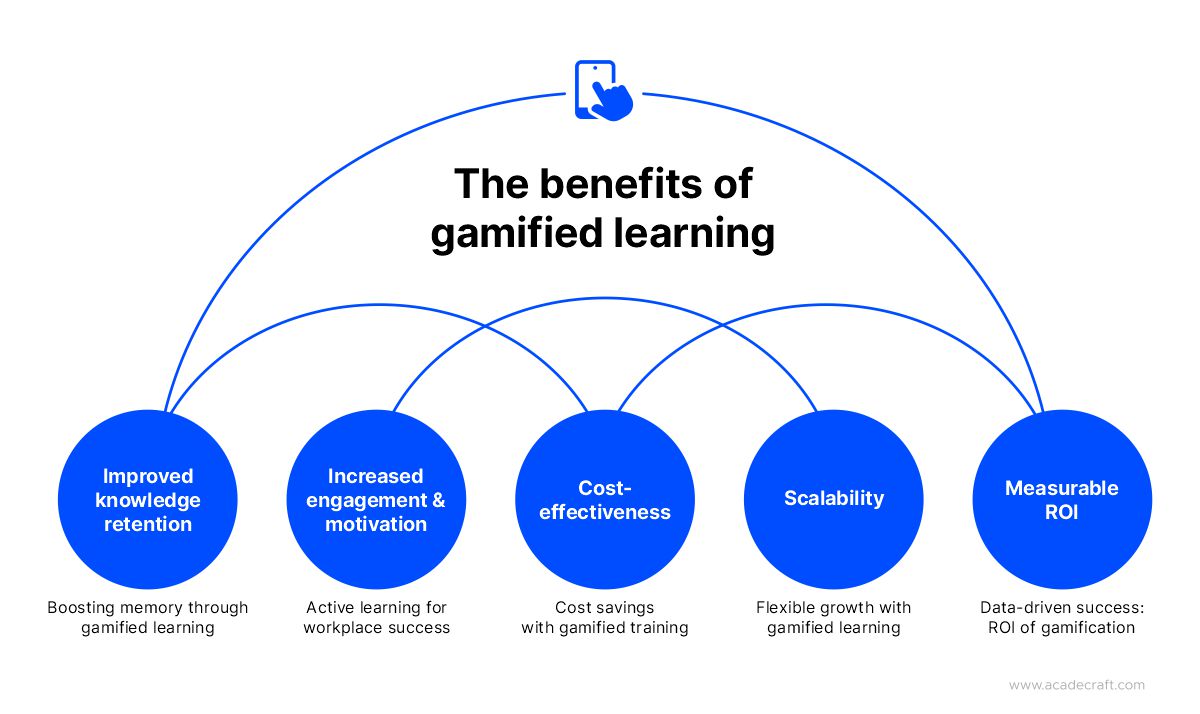
1. Higher Engagement and Motivation
The primary advantage of a gamified e-learning solution is that it enables students to become engaged with their studies. These modules require students to actively participate in their learning process, whereas students can learn through passive methods.
This includes slides and recorded lectures.
The combination of levels, rewards, challenges, and a progression system creates a motivational system that keeps learners engaged. The interactive method creates active learning environments, which students choose to pursue as they want to learn.
2. Better Knowledge Retention
Gamified learning promotes learning by doing. Learners achieve a deeper understanding of information when they engage with virtual situations and choose action and observe results. Repeated gameplay, together with practical use of skill, helps players establish better memory retention.
The learners who consume content through traditional methods will remember less knowledge than those who learn through gameplay.
3. Safe skill practice Environment
Multiple industries need their workers to acquire advanced competencies that develop without creating actual safety hazards. Gamified e-learning solutions deliver a secure environment that lets learners develop their skills by practising tasks.
It helps them to test their methods while they make mistakes in a risk-free space.
4. Real-Time Feedback and Performance Tracking
The main advantage of a game-based learning system exists because they provide learners with immediate feedback. The system delivers immediate feedback to learners that helps them identify their errors and develop their learning techniques.
The system enables organisations to measure performance through different metrics. This includes completion rates, decision accuracy, response times, and skill development
The learning and development team uses this data-based method to discover knowledge deficiencies. This enables them to create customised learning programs and evaluate how effective their training programs are.
5. Improved Critical Thinking & Problem-Solving
The game-based learning method requires students to handle intricate situations. This includes decision trees that need students to research data, weigh choices, and forecast results. This approach promotes students to develop their strategic thinking abilities and their capacity to solve problems.
The process of learning requires students to participate in active cognitive work, which produces outcomes that help them develop their reasoning abilities and their capacity to adjust to new situations, which are essential for success in today’s fast-paced professional world.
6. Scalability Across Teams
A digital learning gamification platform can be deployed across departments, locations, and even global teams with ease. Training can be delivered anywhere because cloud-based systems enable training to proceed without interruption from geographical limitations.
The system allows organisations to provide consistent training programs that match their training needs for both their large and remote office staff members. Organisations can manage their training materials from one central location, which ensures that they can update their content to match the latest operational needs.
The gamification learning solutions create two main benefits through their interactive content, but their educational results show their present shortcomings. Organisations that want to implement this solution need to assess upcoming difficulties because they must match their current plans with the needs that will arise in the future.
1. High Development Cost
The expensive development process serves as the main obstacle that prevents organisations from using game-based learning solutions. The creation of a successful learning game needs instructional designers and subject matter experts, together with game developers, UX designers, and technical teams to work together.
The expenses of developing advanced simulations, together with 3D environments and AR/VR technology implementations, experience significant cost increases. Developing custom solutions that meet specific organisational requirements will require a considerable amount of resources.
The financial requirements that small or mid-sized companies face for their initial investment appear excessive when compared to standard eLearning modules.
2. Time-Intensive Design & Testing
Game-based learning requires educational objectives to match game mechanics, while standard digital courses do not require this level of precision. Badly designed gameplay will overshadow educational purposes, which will result in decreased learning effectiveness.
The design process includes multiple steps. This includes creating storyboards, developing prototypes, conducting user tests, making multiple design revisions, and fixing technical issues.
The development process of this project will take an extended time because several stakeholders need to give their authorisation. Organisations must get ready for extended periods that will last until they achieve their first measurable successes.
3. Risk of Over-Entertainment
Game-based learning brings two advantages through its ability to create student interest, although this quality results in one negative aspect. Excessive entertainment focuses on elements like graphics, competition, and rewards, leading to the learning objectives being lost.
Students will concentrate on achieving victory in the game instead of taking in educational content.
4. Technology Barriers
Educational games need digital systems that connect to advanced technology for their operation. Implementation gets affected by three main factors, which include Learning Management System (LMS) compatibility problems, hardware restrictions, and insufficient internet access.
Some organisations lack high-performance devices that employees need to access immersive simulation training. Operational problems arise from technical failures, software updates, and cybersecurity issues. These barriers may reduce accessibility and slow adoption.
5. Resistance from Traditional Learners
Game-based learning formats do not receive instant acceptance from all students. Senior employees or professionals accustomed to conventional training methods view gamified environments as informal or less serious. People doubt whether "playing a game" actually helps them acquire new skills.
Organizations need to establish learning goals that they must measure and display to stakeholders before executing their change plans. Change management strategies become essential during rollout.
The gamified e-learning solutions require more than interactive training elements, as it needs an organisational approach. This brings business results through specific targeted goals. The implemented process needs to follow structured methods that create specific outcomes that match business performance goals.
1. Define Clear Learning Objectives
All gamified learning solutions start with specific learning objectives that are achieved through a program. Organisations need to determine the particular skills that need development, together.
Game mechanics will become basic engagement tools instead of actual performance drivers without the existence of measurable objectives. The game design path should become clear through the establishment of objectives that show how learning outcomes and business key performance indicators will be achieved.
2. Choose the Right Game Format
Different training needs require different game formats. Simulations work best for technical or compliance training, while scenario-based role-play is effective for leadership and soft skills development.
Microlearning games are ideal for quick knowledge reinforcement. Selecting the right format ensures alignment between content complexity and learner expectations.
3. Collaborate with Instructional Designers
Game mechanics do not provide learning benefits without sufficient learning enhancements. Instructional designers (ID) establish the connection between game elements and education principles that govern learning activities.
The design team creates student challenges, feedback loops, and goal achievement systems, which help students retain knowledge while avoiding information overload. The development of effective educational programs needs collaboration between designers and learning experts, together with video game developers.
4. Pilot Before Scaling
The organisation needs to conduct pilot tests before it can expand its operations to all departments. The small learner group will evaluate three aspects of the system, which include usability, engagement, and clarity. The phase helps to find technical issues, content gaps, and motivational problems.
The process of refining the solution before scaling operations decreases risks while improving the success rates of adoption.
5. Integrate With LMS & Analytics
Gamified learning must not function as a separate entity from the rest of educational programs. The integration process with the organisation’s Learning Management System enables organisations to monitor their students' learning progress, completion rates, and skill acquisition.
The analytics system delivers practical information that helps learning and development teams to enhance their processes continuously.
6. Measure Impact
The project launch marks the beginning of the implementation process. Organisations need to assess their performance through specific measurable metrics. The system measures four specific factors, which include user engagement and user knowledge retention, user behaviour changes, and business performance improvements. Organisations prove their return on investment, which strengthens their commitment to using game-based approaches.
Game-based learning solutions will undergo a rapid transformation in 2026 because of new technological developments and the changing needs of the workforce.
AI-driven personalisation stands as the primary trend according to current research. The system provides learners with customised challenges that match their skill level, thus helping them to develop their knowledge.
The development of virtual and augmented reality technology creates a new trend for immersive educational experiences. VR simulations enable healthcare, manufacturing, and aviation industries to create safe digital environments. This replicates their dangerous real-world situations. The immersive experiences provide advanced practical skill development opportunities together with real-world learning experiences.
Mobile-first game modules have gained acceptance as a new development. Organisations now focus on creating learning experiences that enable remote and hybrid workers to access content from any device.
Microlearning games designed for smartphones enable continuous skill reinforcement without disrupting daily workflows.
The educational field sees the rising popularity of collaborative multiplayer learning as an important development. Team-based challenges help participants to develop their skills in communication and problem-solving while they interact with their colleagues. The method helps to build workplace collaboration between employees who remain focused on their tasks.
Data-driven skill mapping has emerged as the new method that organisations use to shape their implementation procedures. Organisations can better plan their workforce development process through advanced analytics, which connect game performance data with competency frameworks.
The combined trends show that game-based learning has developed into a more intelligent and interactive system that achieves specific business results.
Any organisation aiming to modernise its training programs can achieve better results through the implementation of game-based learning.
The strategic implementation of gamified learning provides organisations with long-term value. The development expenses for gamified learning exceed those of traditional training methods, yet the resulting benefits of increased user engagement, better completion rates, greater knowledge retention, and improved performance outcomes make the costs worthwhile.
The solution needs to match business objectives, which requires measurement of return on investment through analytic methods.
The training world has experienced a major change through gamified learning solutions. This creates new possibilities for training development. The platform enables users to develop their skills through interactive learning. This combines assessment systems and complete learning environments.
The implementation process demands careful resource allocation. This approach can enhance learning results and workforce efficiency, as it makes an attractive method for use in 2026 and later. You want to know more, you can contact Acadecraft today!


Share
Acadecraft has been an invaluable partner in our journey towards excellence in certification. Their commitment to delivering exceptional service, coupled with their unwavering dedication to timeliness and quality, has truly set them apart.
From the outset, their team has demonstrated a keen understanding of our needs, consistently delivering reports with meticulous attention to detail. Their responsiveness is commendable; whenever we've reached out with queries or requests, they've always been prompt and accommodating, ensuring a smooth and seamless experience.
One of the standout aspects of Acadecraft's service is their ability to deliver reports in a timely manner without compromising on quality. This has been instrumental in our decision-making processes, allowing us to make informed choices based on accurate and insightful data.
Acadecraft has consistently exceeded our expectations with their exemplary service, timely responsiveness, and unwavering commitment to quality.

Acadecraft's Voice-Over service was amazing! The team provided accurate and culturally relevant recordings for what we expected. They showed true professionalism and expertise. We highly recommend Acadecraft for their excellent Voiceover services.

Always impressed with Acadecraft's expertise! Their translation services play a vital role for our company to drive international growth within our team and clients.

AcadeCraft's assessment content creation team was able to understand our unique requirements and created customized assessments that fit our needs. The team was prompt and professional, and the quality of their work was good.

Acadecraft have recorded several audiobooks for us. They have a wide range of talented artists with different accents who really bring our stories to life. Their work is of high quality, with good attention to detail.
Acadecraft are reliable, efficient and friendly. Their services are highly recommended by us.

As a producer, I've had the pleasure of using Acadecraft for sourcing VO and liaising with artists for several film projects. They offer a wide range of VO profiles and the artists I have collaborated with all were talented and professional. The team at Acadecraft have supported me with great professionalism, responsiveness and creativity. I highly recommend their services.

Acadecraft has been helpful with connecting our editorial team with subject matter experts (SMEs) who help us QA assessments and create solutions for computational assessments. They have been able to find SMEs to meet our needs and our deadlines. We are happy to continue to partner with Acadecraft.

Acadecraft team is always very supportive, and we and Acadecraft corroborate to create educational contents for K12 Students in India.
We appreciate Acadecraft teams' professionality, punctuality, creation skills in each subject.

I am thrilled to share my testimonial for Acadecraft which creates interactive and engaging content. Working with this team has been an absolute pleasure from start to finish. Not only did they create outstanding content for our project, but they also went above and beyond to ensure that it was interactive, engaging, and effective.
Throughout the entire process, the team was highly cooperative and communicative, always available to resolve any issues or concerns that arose. They truly made us feel like partners in the project, and their dedication to delivering high-quality content was evident in every interaction.
Thanks to their exceptional work, our project was a huge success, and we couldn't be happier with the results. I highly recommend them to anyone looking for a team that is passionate, professional, and committed to excellence. Wishing them all the best in their future endeavors.

The team at Acadecraft has truly been an end-to-end service provider for us, providing content development services and their commitment, attention to detail and expertise have made the project a success. Their team's dedication, attention to detail, and expertise have been unmatched, making our partnership an absolute pleasure. We highly recommend Acadecraft to anyone looking for a reliable and efficient education solutions provider.

Our experience working with Acadecraft has been great. Their highly knowledgeable team of experts was always available to answer our questions, provide guidance, and ensure we were delighted with the services. Their thorough, accurate assessments provided valuable insights that helped us make informed decisions about our exam performances.
We look forward to continuing our partnership with Acadecraft and leveraging their expertise to help us achieve our business goals.

I recently used Acadecraft's Video Editing services and I am extremely impressed with the quality of their work. The team at Acadecraft was highly professional, attentive and skilled in delivering my company’s project on time and within budget.
Their attention to detail was impeccable, and they understood my needs and requirements very well. They were able to create a video that not only met my expectations, but far exceeded them.
Throughout the process, they kept me informed and updated on the progress of the project, and were always available to answer any questions I had. Their customer service was excellent, and they were always friendly and easy to work with.
I highly recommend Acadecraft's Video Editing services to anyone who is looking for a high-quality and professional video editing experience. They are truly experts in their field and I look forward to working with them again in the future.

The video creation team of Acadecraft is insightful. They understood my requirements carefully and delivered a winning video that perfectly aligned with my business needs.
With a good script, content, sound, and editing – Acadecraft helped me with the best video content to strategize my marketing and promotional campaigns. Their tremendous experience in video editing and professionalism in serving the customer before and after delivering services are commendable.
The passionate team knows great about getting into the details and providing impeccable video services. I am extremely impressed by the work Acadecraft has delivered to me.
I appreciate my collaboration with Acadecraft and look forward to availing of services again.

I required an explainer video for my business, and I am mesmerized by the work Acadecraft’s video editing team delivered to me. The perfectly aligned video elements and superb editing demonstrate the experience, knowledge, and professionalism Acadecraft has.
Acadecraft’s 3d video solutions are amazing. They used a perfect blend of art, color, shape, sound, and editing to create the video, making the video engaging and immersive.
I have always been excited to explore the opportunities of videos in business, and it was my pleasure to make Acadecraft my companion for the best video solutions. I highly recommend this organization and would love to collaborate with them again.

With a holistic approach to creating powerful blended videos, Acadecraft delivered me a well-developed video solution. I appreciate the relentless efforts of the video editing team, whose in-depth knowledge and analytical skills effectively catered to my needs.
The services Acadecraft has given me exceeded my expectations; the team was effective and listened to my requirements carefully, and went the extra mile in researching and creatively developing awesome pieces of video content.
Not only from a quality perspective but on the management and delivery front, Acadecraft’s services are prolific. They stuck to the turnaround time and were constantly in touch with me throughout the creation process.
I recommend Acadecraft for video solutions as they have great hands-on use of animation, graphics, and other creative assets.

I am thoroughly astounded by Acadecraft's proficient skills! Their exceptional voiceover and translation services were instrumental in amplifying our marketing endeavors and video promotions. They enabled us to communicate effectively with varied audiences and significantly propelled growth across numerous media platforms.

Working along with Acadecraft has been an exceptional journey. Their meticulous attention to detail and commitment to maintaining the essence of the content in the transition from English to Arabic was truly impressive. The collaborative spirit and timely communication made the entire process smooth and enjoyable. Without a doubt, I wholeheartedly endorse their services for a remarkable translation experience.

I am delighted to share my feedback with you on working on the editing and print layout of 9 documents under the KECF project. Overall, I am very happy with the speed with which these documents were edited and the fine attention to details. I also deeply appreciate the quick corrections that were made on our request. Particularly, working with Sanjana was a real pleasure, as I found her very attentive to our requests and her internal quality checks before she sent the documents to us greatly reduced my workload. So many thanks Sanjana! I look forward to working with your agency if such a need arises in future too. Many thanks to Sanjana and your entire team.

I am pleased to share that Acadecraft has demonstrated an excellent understanding of our Operations processes, ensuring a smooth and efficient knowledge transfer. The team, including the project coordinators, is highly responsive and addresses any concerns swiftly leading to effective resolutions and seamless delivery.

With our continued global expansion and projects- it was necessary that we join in partnership with Acadecraft. As they have assisted us in increasing production value in all sectors of our company; providing great infrastructure with top professionals. Acadecraft represents efficiency to execution to many of our projects and initiatives with a standard of excellence unmatched.