 By:
Marilyn Schenk
By:
Marilyn Schenk 
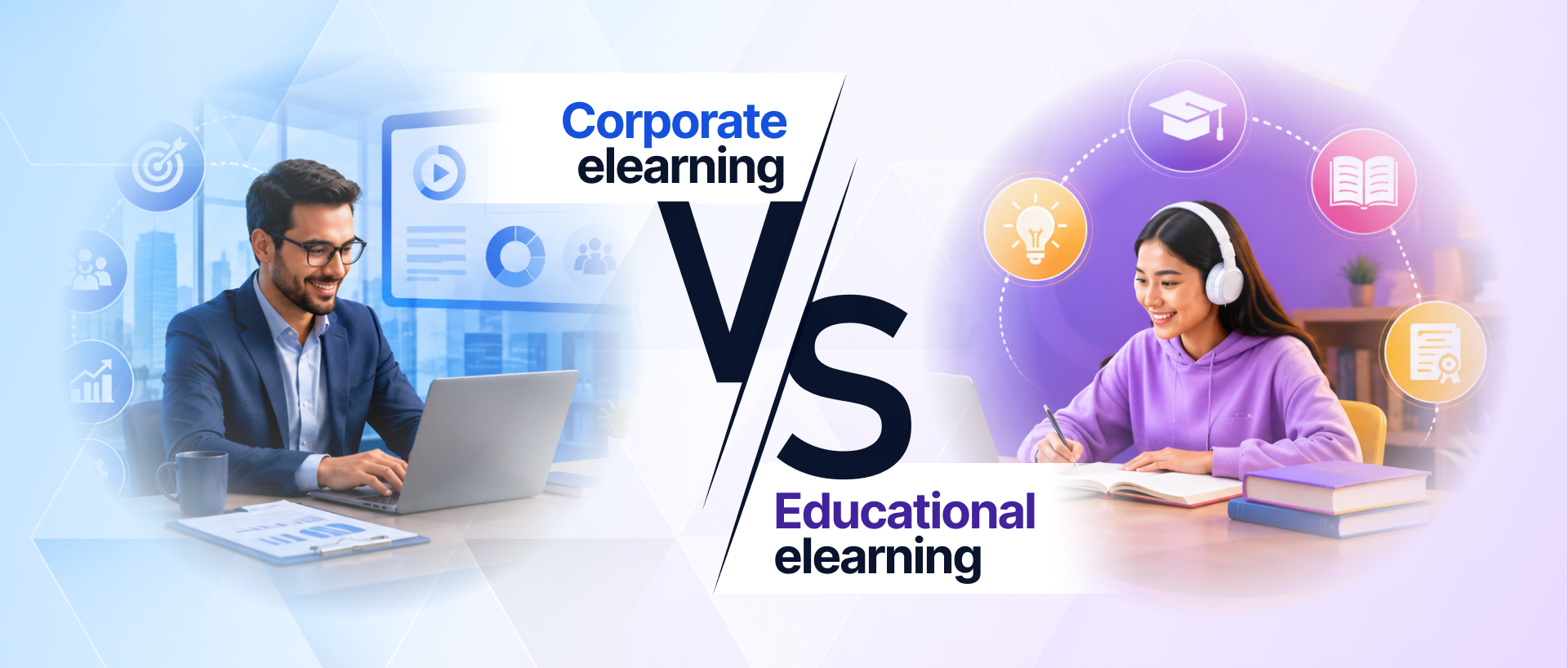
Have you noticed that when you interact with a business that is growing and rapidly hiring new employees to sustain its workforce in accordance with work in the growth, its workforce is slower or completely stagnant in terms of growth in performance, producing quality content, onboarding, issues in team coordination, and error rates?
According to Training Magazine, corporate training solutions investment grew 4.9% year over year from $98 billion in 2024 to $102.8 billion in 2025. The increase in budget informs us that the markets are growing and traditional learning methods are not working anymore; that is why companies are choosing corporate solutions providers for expertise.
Growing companies need a training format that allows them to sustain themselves even with a changing environment, demands, regulations, and standards. Traditional learning is far off the charts because a curriculum that bores learners can’t be effective. However, e-learning solutions demonstrate they can keep pace with growing workforces, and interactive multimedia tools drive engagement.
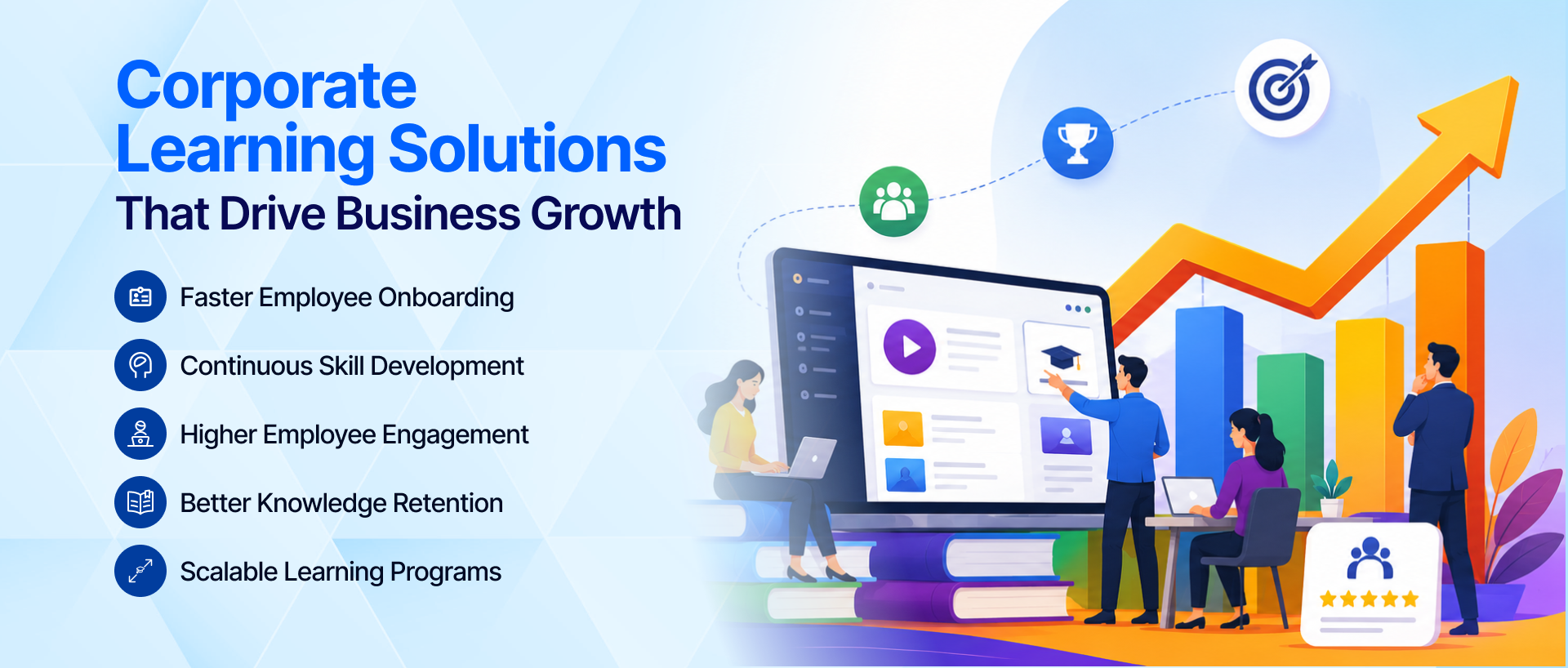
Corporate training solutions offer structured programs and tools that employees can use to build skills and knowledge and maintain performance, even at scale, through digital content and flexible platform access. The corporate solutions providers bridge the gap between individual capabilities and company goals by focusing on content delivery methods.
For growing teams, the corporate learning solutions are designed to function at a larger scale. Regardless of whether the learners are 50 or 50,000 in number.
A growing company has to conduct rapid hiring, which also means mass training. Without a standard form of corporate eLearning, teams get distributed instead of being in cohorts, such as one employee assisting a senior executive in learning while the other trains themself with a content library. This creates a rift in understanding regarding the same topic.
But when the employees are provided with corporate online learning, they receive a structured, scalable, and repeatable program for onboarding new workers without needing a trainer or experienced colleague.
Employees need knowledge from a verified professional to grow themselves, and training is not facilitated by a trainer who barely has any experience working on a sales team or whatever the requirements are. Without viable learning sources, employees will not be able to relate to or engage with training, which means a waste of time and resources.
And corporate online training programs remove this factor because the obvious is same training is provided. Still, the development of that program requires centralization of distributed institutional knowledge by experts of the company so the knowledge does not leave with a person.
When a company has a smaller workforce, it is easier to manage compliance through proximity and conversations. But when the company grows, the process falters due to the intervention of larger teams, more jurisdiction, and more regulations; the same approach can trigger unequal distribution of compliance knowledge, leading to more issues.
But this problem is resolved through corporate eLearning platforms that provide training digitally with proper documentation to prove that every worker is compliance-trained. Though risk does not disappear but becomes manageable and provable.
As per traditional beliefs, a workforce can only perform well if the manager is highly interactive with the learner. This is partly true for the traditional training system where employees attend scheduled lectures of theory and can only learn skills if the manager provides them an opportunity to apply that knowledge at work and master it.
But beyond that, corporate eLearning does not highly depend on managers to help learners at every step, putting their work and goals aside. Everyone can complete learning on the learning management system, and managers can check the aftermath on the platform.
When organisations decide their workforce needs both internal trainers and external facilitators for more focused and higher-quality training. Then investment grows linearly with headcount due to requirements of trainer time in different cohorts and still demands outpace capacity.
But corporate solutions providers separate trainer delivery from trainer availability. The content is delivered once and scaled without any extra cost. This facilitates learning for new cohorts at different locations and employees joining throughout the year.
When the workforce is continuously growing, the organisation has to invest in corporate training solutions. It would be a more sensible choice to invest in a custom program so the company can leverage it for a long time and drive better outcomes.
Off-the-shelf generic programs cover applicable principles very broadly and invent scenarios and assume an average starting point, even though it is humanly impossible that a workforce of 500 employees has the same levels of knowledge, understanding, and capabilities. This affects the performance of learners.
A logistics company does not need the same training format as healthcare professionals, and this is exactly where Custom e-learning solutions step in. Here, the program is completely built around the organisation as it actually exists. This powers relevancy in training, which is the biggest factor for driving engagement; this connects to retention and application of knowledge.
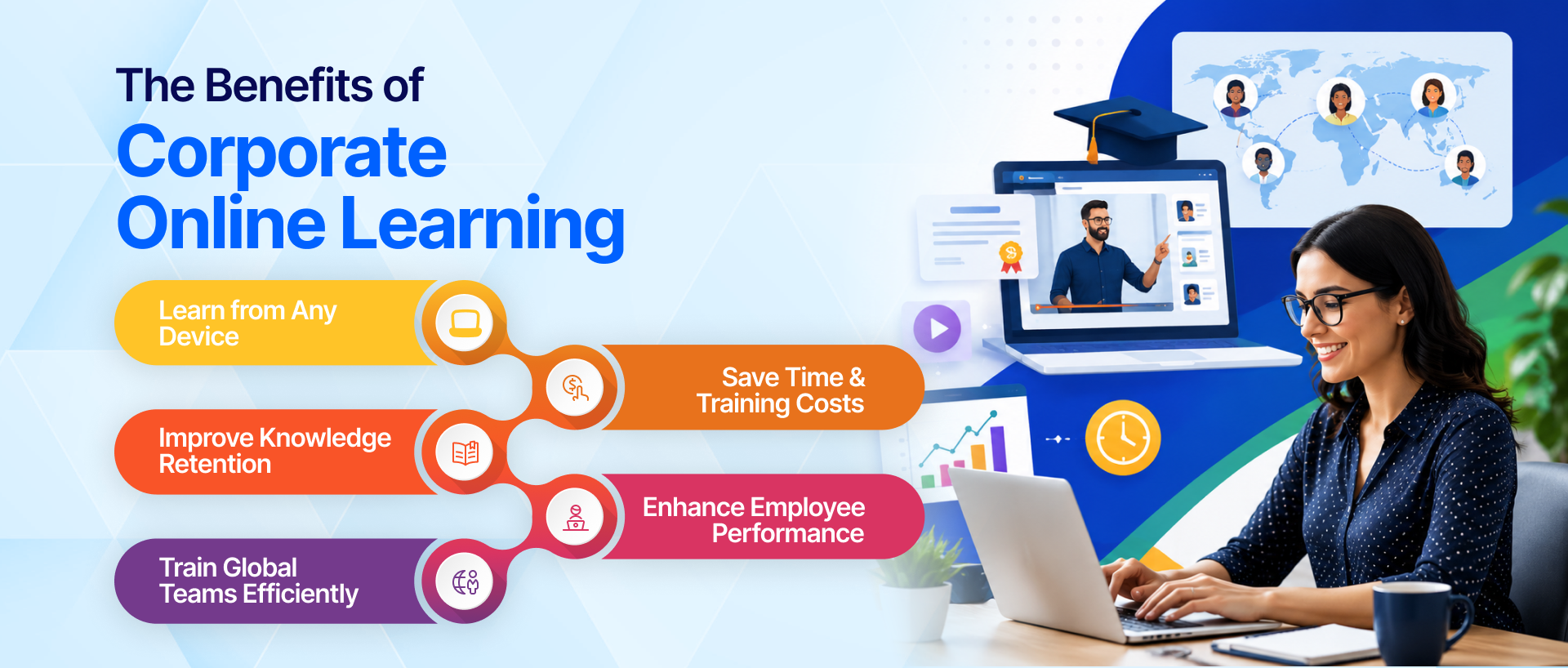
Let us discuss the benefits of corporate learning solutions beyond what the programs contribute to major issues that organisations face with a growing workforce.
Corporate online training for employees does not ask employees to step away from their job role to develop skills. Instead, learning meets every learner where they already are, such that it is right for their client meeting or analyst reviews a framework before quietly reporting it. This benefits the retention power of employees and the capability to act on time.
Using corporate eLearning platforms prevents organisations from outgrowing their training approach, and that is made possible because the format is architected for scaling, whether they have to train 50 or 50,000 learners without any proportional cost increase. At this point, companies gain the power to spend their budget on more meaningful aspects.
An employee in a satellite office should not receive a worse version of organisational training only because no trainer was available to fly out. Corporate e-learning solutions benefit growing organisations by removing the geographical factor with the help of digital content delivery to the employees.
On the corporate learning platforms, the learning & development team and managers can track learners' activities, and the system itself flags failed attempts. This paints a real picture of where the workforce is growing rightfully and where they are stagnant and need support before the gaps turn into performance failures.
Many of the young employees, especially Gen Z and millennials, do not believe in the hustle culture as the older generations did. Now, employees maintain a clear line between career and life that contributes to quality of personal life. Corporate solutions providers understood the problem and operate a more flexible system for learners where content is deployed once and learners are expected to complete in the given time window.
To keep pace with growing markets and workforces simultaneously, the leaders or founders of organizations need good strategies and, more importantly, budgets. And continuous training is important to maintain the streak; L&D with less budget cannot achieve this. But corporate learning benefits them by reducing the per-learner cost of development significantly.
A growing workforce creates complexity due to more people, roles, processes, markets, and decisions to make. Effective corporate online training programs ensure that complexities don’t turn into chaos.
An organisation with effective programs can update its employees' knowledge when needed, keep check on regulations, and change processes that carry less risk than the previous ones. They don’t need to continuously hire external gig workers to get the pending work done.
When the corporate elearning platforms are designed in a modular format, updating content becomes easier, and ongoing training is also not disrupted. Awareness about compliance regulations, product usage, machinery working, and kinds of information prevents any major legal problems.
Programs aren’t effective from the development phase, though that does play a significant role; effectiveness comes from organisations that treat training as infrastructure that is proactive, not reactive.
Growing organisations often struggle to maintain informal knowledge transfer in the workplace. Corporate online learning solutions make the flow of learning formal with digital training that does not require any manager, regardless of their joining quarter.
Acadecraft has two main agendas in their service-providing portfolio: first, facilitate localized training content regardless of geographical barriers; and second, provide the option of making any format of e-learning custom. For growing employees, personalised training can also be more effective.
The answer to this question is mostly dependent on the scope and format of corporate eLearning platforms. For instance, a simple program using existing content and rapid authoring tools can be built in 1 week. On the other hand, a fully immersive and custom program with gamification, mobile-enabling, assessment, scenarios, and multimedia elements can take months before deployment.
Acadecraft has a diverse range of e-learning solutions for training a growing workforce. They are technologically advanced, and their strategic teams make corporate learning solutions immersive, engaging, and effective. Their programs are focused on leadership development, onboarding training, compliance, sales training, tech learning, soft skill training, customer-facing training, and more.
The major issues that growing organisations face are rising training costs, an unskilled workforce, and team incompetence. Corporate training solutions change that with digital content delivery, role-specific modules, and scalable & repeatable content without any extra charge.
When programs are designed to address training at three different levels: individual, team, and organisational, then the focus of corporate elearning platforms shifts from only compliance or onboarding to major skill development that keeps pace with business growth in real time.
As an edtech and content developer, Acadcearft positions itself as a learning partner for organisations that have witnessed growth in their business but are struggling to scale that curve in employees as well. The learning strategy team assesses demands & needs, and developers build e-learning solutions for betterment.

Share
Acadecraft has been an invaluable partner in our journey towards excellence in certification. Their commitment to delivering exceptional service, coupled with their unwavering dedication to timeliness and quality, has truly set them apart.
From the outset, their team has demonstrated a keen understanding of our needs, consistently delivering reports with meticulous attention to detail. Their responsiveness is commendable; whenever we've reached out with queries or requests, they've always been prompt and accommodating, ensuring a smooth and seamless experience.
One of the standout aspects of Acadecraft's service is their ability to deliver reports in a timely manner without compromising on quality. This has been instrumental in our decision-making processes, allowing us to make informed choices based on accurate and insightful data.
Acadecraft has consistently exceeded our expectations with their exemplary service, timely responsiveness, and unwavering commitment to quality.

Acadecraft's Voice-Over service was amazing! The team provided accurate and culturally relevant recordings for what we expected. They showed true professionalism and expertise. We highly recommend Acadecraft for their excellent Voiceover services.

Always impressed with Acadecraft's expertise! Their translation services play a vital role for our company to drive international growth within our team and clients.

AcadeCraft's assessment content creation team was able to understand our unique requirements and created customized assessments that fit our needs. The team was prompt and professional, and the quality of their work was good.

Acadecraft have recorded several audiobooks for us. They have a wide range of talented artists with different accents who really bring our stories to life. Their work is of high quality, with good attention to detail.
Acadecraft are reliable, efficient and friendly. Their services are highly recommended by us.

As a producer, I've had the pleasure of using Acadecraft for sourcing VO and liaising with artists for several film projects. They offer a wide range of VO profiles and the artists I have collaborated with all were talented and professional. The team at Acadecraft have supported me with great professionalism, responsiveness and creativity. I highly recommend their services.

Acadecraft has been helpful with connecting our editorial team with subject matter experts (SMEs) who help us QA assessments and create solutions for computational assessments. They have been able to find SMEs to meet our needs and our deadlines. We are happy to continue to partner with Acadecraft.

Acadecraft team is always very supportive, and we and Acadecraft corroborate to create educational contents for K12 Students in India.
We appreciate Acadecraft teams' professionality, punctuality, creation skills in each subject.

I am thrilled to share my testimonial for Acadecraft which creates interactive and engaging content. Working with this team has been an absolute pleasure from start to finish. Not only did they create outstanding content for our project, but they also went above and beyond to ensure that it was interactive, engaging, and effective.
Throughout the entire process, the team was highly cooperative and communicative, always available to resolve any issues or concerns that arose. They truly made us feel like partners in the project, and their dedication to delivering high-quality content was evident in every interaction.
Thanks to their exceptional work, our project was a huge success, and we couldn't be happier with the results. I highly recommend them to anyone looking for a team that is passionate, professional, and committed to excellence. Wishing them all the best in their future endeavors.

The team at Acadecraft has truly been an end-to-end service provider for us, providing content development services and their commitment, attention to detail and expertise have made the project a success. Their team's dedication, attention to detail, and expertise have been unmatched, making our partnership an absolute pleasure. We highly recommend Acadecraft to anyone looking for a reliable and efficient education solutions provider.

Our experience working with Acadecraft has been great. Their highly knowledgeable team of experts was always available to answer our questions, provide guidance, and ensure we were delighted with the services. Their thorough, accurate assessments provided valuable insights that helped us make informed decisions about our exam performances.
We look forward to continuing our partnership with Acadecraft and leveraging their expertise to help us achieve our business goals.

I recently used Acadecraft's Video Editing services and I am extremely impressed with the quality of their work. The team at Acadecraft was highly professional, attentive and skilled in delivering my company’s project on time and within budget.
Their attention to detail was impeccable, and they understood my needs and requirements very well. They were able to create a video that not only met my expectations, but far exceeded them.
Throughout the process, they kept me informed and updated on the progress of the project, and were always available to answer any questions I had. Their customer service was excellent, and they were always friendly and easy to work with.
I highly recommend Acadecraft's Video Editing services to anyone who is looking for a high-quality and professional video editing experience. They are truly experts in their field and I look forward to working with them again in the future.

The video creation team of Acadecraft is insightful. They understood my requirements carefully and delivered a winning video that perfectly aligned with my business needs.
With a good script, content, sound, and editing – Acadecraft helped me with the best video content to strategize my marketing and promotional campaigns. Their tremendous experience in video editing and professionalism in serving the customer before and after delivering services are commendable.
The passionate team knows great about getting into the details and providing impeccable video services. I am extremely impressed by the work Acadecraft has delivered to me.
I appreciate my collaboration with Acadecraft and look forward to availing of services again.

I required an explainer video for my business, and I am mesmerized by the work Acadecraft’s video editing team delivered to me. The perfectly aligned video elements and superb editing demonstrate the experience, knowledge, and professionalism Acadecraft has.
Acadecraft’s 3d video solutions are amazing. They used a perfect blend of art, color, shape, sound, and editing to create the video, making the video engaging and immersive.
I have always been excited to explore the opportunities of videos in business, and it was my pleasure to make Acadecraft my companion for the best video solutions. I highly recommend this organization and would love to collaborate with them again.

With a holistic approach to creating powerful blended videos, Acadecraft delivered me a well-developed video solution. I appreciate the relentless efforts of the video editing team, whose in-depth knowledge and analytical skills effectively catered to my needs.
The services Acadecraft has given me exceeded my expectations; the team was effective and listened to my requirements carefully, and went the extra mile in researching and creatively developing awesome pieces of video content.
Not only from a quality perspective but on the management and delivery front, Acadecraft’s services are prolific. They stuck to the turnaround time and were constantly in touch with me throughout the creation process.
I recommend Acadecraft for video solutions as they have great hands-on use of animation, graphics, and other creative assets.

I am thoroughly astounded by Acadecraft's proficient skills! Their exceptional voiceover and translation services were instrumental in amplifying our marketing endeavors and video promotions. They enabled us to communicate effectively with varied audiences and significantly propelled growth across numerous media platforms.

Working along with Acadecraft has been an exceptional journey. Their meticulous attention to detail and commitment to maintaining the essence of the content in the transition from English to Arabic was truly impressive. The collaborative spirit and timely communication made the entire process smooth and enjoyable. Without a doubt, I wholeheartedly endorse their services for a remarkable translation experience.

I am delighted to share my feedback with you on working on the editing and print layout of 9 documents under the KECF project. Overall, I am very happy with the speed with which these documents were edited and the fine attention to details. I also deeply appreciate the quick corrections that were made on our request. Particularly, working with Sanjana was a real pleasure, as I found her very attentive to our requests and her internal quality checks before she sent the documents to us greatly reduced my workload. So many thanks Sanjana! I look forward to working with your agency if such a need arises in future too. Many thanks to Sanjana and your entire team.
I am pleased to share that Acadecraft has demonstrated an excellent understanding of our Operations processes, ensuring a smooth and efficient knowledge transfer. The team, including the project coordinators, is highly responsive and addresses any concerns swiftly leading to effective resolutions and seamless delivery.

With our continued global expansion and projects- it was necessary that we join in partnership with Acadecraft. As they have assisted us in increasing production value in all sectors of our company; providing great infrastructure with top professionals. Acadecraft represents efficiency to execution to many of our projects and initiatives with a standard of excellence unmatched.