 By:
Marilyn Schenk
By:
Marilyn Schenk 
The invention of many new technologies has changed the way employees work, organisations function, and even how people think. The demands have changed drastically for consumers & providers and continue to vary and increase; as a result, off-the-shelf courses no longer fit training needs.
On the other hand, custom e-learning development is a strong fit because the organisation can own the content, update it easily, keep it role-focused, and personalise it for employees.
Nearly 39% of workers' current skills will no longer be of use by the year 2030, and more than 75% of skill requirements have changed over the past three years, as per Training Orchestra.
When custom e learning development is done right with a capable learning provider that has experience in the industry and a successful track record, most of the issues are resolved right there.
The process of developing custom eLearning solutions starts from scratch to match the training requirements of the workforce. The content is designed specifically around the organisation's roles, workflows, systems, compliance needs, and real-life situations employees actually face. This process involves instructional designers who translate knowledge, content developers who build interactive elements, and subject matter experts who contribute real-world knowledge for digital programs.
Personalized programs are differentiated from off-the-shelf generic courses in that custom content is owned by the organisation, and it is more specific. On the other hand, generic programs are licensed. Hence, learners cannot make any changes.
To answer this question, you will have to dig deeper into what issues off-the-shelf programs failed to solve. It's about the difference between options and what learners need. Generic content is designed for broad application, covering topics, not jobs, and teaches about existing principles, not how to make decisions.
On the other hand, customized learning solutions are designed around specific problems the workforce and business are already facing. Generic programs cannot address them in any given situation. A custom program would solve the issue by building knowledge and then practising through scenarios, decision-making, and assessments.
This makes the choice simple: if there is an option available for solving the existing issue, why would another choice matter in the comparison? It would not. In conclusion, we can say custom e learning solutions matter to organisations because of their problem-solving format.
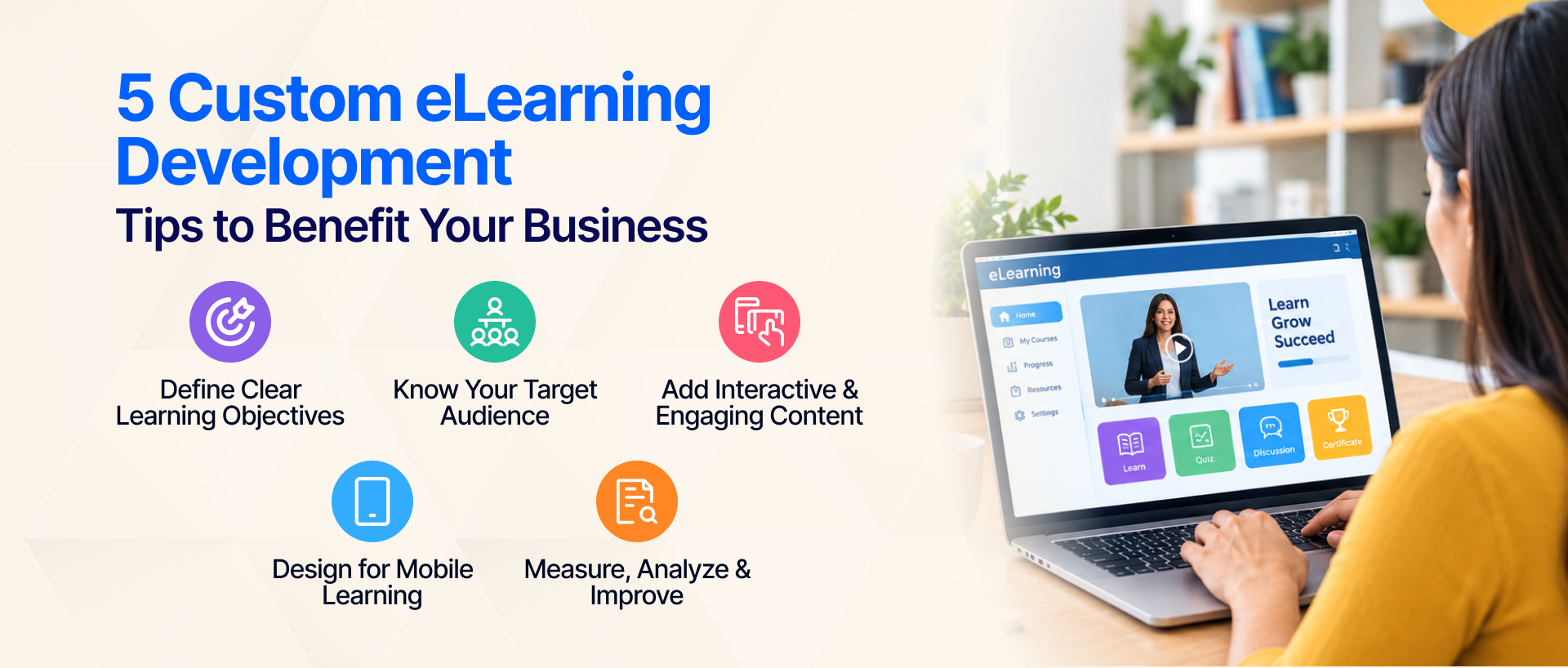
The content developers often start the development with the wrong question when they ask, "What should the employees know?" while they should be asking, "What is the purpose of training, and what behaviour changes are needed?" Such questions make a huge difference in the content of customized learning solutions.
A program designed after the first question will only transfer knowledge related to the type of training employees need. But the program designed after the second question will target decision-making, behaviour changes, and actions needed to fill the gap. This helps the organisation create an effective learning chain.
One of the main purposes of a provider of custom e-learning development is to build relevant and accurate content based on an understanding of learners. A clear quality distinction is shown in the course when it's created after assessing the learner beyond the job title. The knowledge about their actual working conditions, how much time they have for training, preferred devices, and specific gaps as per them.
Organisations that skip the assessment phase of the process often end up creating generic content because the knowledge about learners is what shapes the entire purpose of each module and decision-making, whether we talk about module length, complexity level, vocabulary, or assumed baseline.
Custom e learning development requires a team to collaborate for one program, and each member of the team should bring a different quality or skill to the project. Subject matter experts add valuable real-life knowledge to make content more credible, and when they collaborate with instructional designers, the same knowledge is turned into content structured around learning objectives and business goals.
For instance, a company hired an instructional designer solely to develop custom e learning solutions, and they already have internal subject matter experts. When they create a training program, it would contain interactive content, but to complete the program, a content designer is necessary. It's a team effort.
4. Treat the first module as a pilot
The first module of custom e learning solutions should be treated as a test of what the learning pattern can create that would help organisations achieve their business goals and would close the skill gap of the workforce. In the first module, everything is designed based on the learner's preference, so the learning & development team should review the built content and provide structured feedback that developers could use to make the final program more effective.
If the first piece of content never gets reviewed with proper feedback, then the end program is not valuable even after spending a high budget on the program development. To fix the error, changes are important that make the entire process more expensive and time-consuming.
5. Plan measurement before development begins
Before the custom e-learning development process even begins, an important question needs to be answered: "How will the training be evaluated?" This is important design input, and when this is considered after the program is developed or, worse, launched, the team would have no data to figure out any improvements.
If the program is built to improve onboarding time, a baseline needs to be established, and current data needs to be stored. When the employees complete training and use knowledge at work, then the team can compare the prior data to current data and track improvement and areas where more work is needed. Without planning measurement beforehand, the whole process would have no visible outcomes.
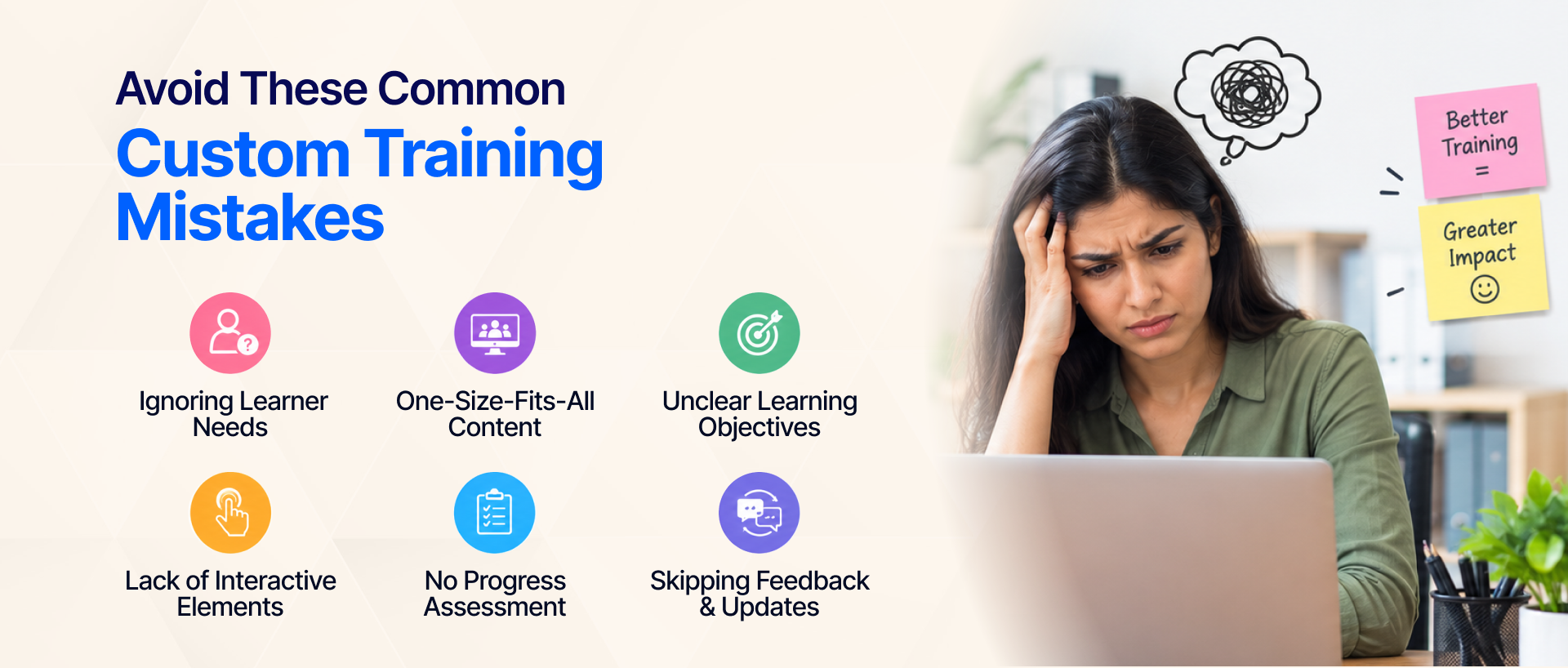
When the development of custom eLearning solutions is discussed, different departments have a say about content, such as company stakeholders wanting every policy covered and subject matter experts wanting everything included, but excessive content impacts training negatively with cognitive load and lower retention. Every piece of content should add value; if it does not pass the criteria, then modules should not include it.
When a company decides its workforce needs a training program, the development team needs approval from different stakeholders, such as L&D, SMEs, compliance officers, senior leadership, and team managers. But the team should know the difference between getting approval and being willing to impress others, even when it demands making changes. To maintain the quality of content, the team should push back on feedback if it is unnecessary.
The biggest perk of customized learning solutions is that organisations can own the program and make changes as per their preference and need. But many organisations treat the entire development process as just a project, and launch is the finish line even though it is the start of a maintenance cycle. Without any updates about new products, process changes, or any other organisation-related changes, the learners keep on indulging in obsolete content.
Best practices are well-used and proven methods that can drive favourable learning outcomes, enhance training outcomes, or contribute to the betterment of the program.
It has been repeatedly noticed that learners are more likely to engage with modular content and, more specifically, modules built around a clearly defined outcome. When each unit carries a single objective and interactive assessments, the cognitive load is manageable.
Though content can be designed with existing supporting tools available in the market, for building a learning experience, developers have to consider meeting learners. They will only be able to engage with training when it answers the question they already have. The "A list of things employees should know” format is repulsive to talented workers.
Lastly, the best practice organisations could choose is in the content and its delivery. If the custom eLearning solutions include personalised content but without any means to practice, the employees would never be able to apply the knowledge at work. That is why scenarios that reflect consequences are an absolute need. Now, the entire charade needs a flexible delivery on the personal device of the learner, so they learn when they have time without needing any strict schedule.
To choose a capable learning provider, the L&D (learning and development) team should begin by checking the portfolio of different service providers and pay brief attention to business cases, learning retention rates, industry experience, and reviews from other clients. Then, in demo sessions, take notice of the questions they ask about goals, market, and outcomes. Only after assurance that the provider has done similar projects previously and had a successful attempt to take the process further.
The market is growing faster than some businesses can keep pace with, and directly or indirectly widening skill gaps are one of the reasons behind this rift. To solve this business crisis, custom e-learning development has proven to be one of the best methods due to its capability to be adaptive, personalised, and goal-focused.
A business with gaps and poor alignment always seems to be struggling because of a weaker foundation; the root cause is an under-skilled workforce. To overcome this with custom eLearning solutions, a learning partner is required who is an expert in developing custom content aligned with business issues and employee training needs.
The custom e learning development by Acadrcraft closes existing gaps and rifts by providing content that relates to real-life problems employees face, with the use of the right technology that makes the facilitation more engaging and flexible for the workforce. If you want to know more, you can contact Acadecraft today!

Share
Acadecraft has been an invaluable partner in our journey towards excellence in certification. Their commitment to delivering exceptional service, coupled with their unwavering dedication to timeliness and quality, has truly set them apart.
From the outset, their team has demonstrated a keen understanding of our needs, consistently delivering reports with meticulous attention to detail. Their responsiveness is commendable; whenever we've reached out with queries or requests, they've always been prompt and accommodating, ensuring a smooth and seamless experience.
One of the standout aspects of Acadecraft's service is their ability to deliver reports in a timely manner without compromising on quality. This has been instrumental in our decision-making processes, allowing us to make informed choices based on accurate and insightful data.
Acadecraft has consistently exceeded our expectations with their exemplary service, timely responsiveness, and unwavering commitment to quality.

Acadecraft's Voice-Over service was amazing! The team provided accurate and culturally relevant recordings for what we expected. They showed true professionalism and expertise. We highly recommend Acadecraft for their excellent Voiceover services.

Always impressed with Acadecraft's expertise! Their translation services play a vital role for our company to drive international growth within our team and clients.

AcadeCraft's assessment content creation team was able to understand our unique requirements and created customized assessments that fit our needs. The team was prompt and professional, and the quality of their work was good.

Acadecraft have recorded several audiobooks for us. They have a wide range of talented artists with different accents who really bring our stories to life. Their work is of high quality, with good attention to detail.
Acadecraft are reliable, efficient and friendly. Their services are highly recommended by us.

As a producer, I've had the pleasure of using Acadecraft for sourcing VO and liaising with artists for several film projects. They offer a wide range of VO profiles and the artists I have collaborated with all were talented and professional. The team at Acadecraft have supported me with great professionalism, responsiveness and creativity. I highly recommend their services.

Acadecraft has been helpful with connecting our editorial team with subject matter experts (SMEs) who help us QA assessments and create solutions for computational assessments. They have been able to find SMEs to meet our needs and our deadlines. We are happy to continue to partner with Acadecraft.

Acadecraft team is always very supportive, and we and Acadecraft corroborate to create educational contents for K12 Students in India.
We appreciate Acadecraft teams' professionality, punctuality, creation skills in each subject.

I am thrilled to share my testimonial for Acadecraft which creates interactive and engaging content. Working with this team has been an absolute pleasure from start to finish. Not only did they create outstanding content for our project, but they also went above and beyond to ensure that it was interactive, engaging, and effective.
Throughout the entire process, the team was highly cooperative and communicative, always available to resolve any issues or concerns that arose. They truly made us feel like partners in the project, and their dedication to delivering high-quality content was evident in every interaction.
Thanks to their exceptional work, our project was a huge success, and we couldn't be happier with the results. I highly recommend them to anyone looking for a team that is passionate, professional, and committed to excellence. Wishing them all the best in their future endeavors.

The team at Acadecraft has truly been an end-to-end service provider for us, providing content development services and their commitment, attention to detail and expertise have made the project a success. Their team's dedication, attention to detail, and expertise have been unmatched, making our partnership an absolute pleasure. We highly recommend Acadecraft to anyone looking for a reliable and efficient education solutions provider.

Our experience working with Acadecraft has been great. Their highly knowledgeable team of experts was always available to answer our questions, provide guidance, and ensure we were delighted with the services. Their thorough, accurate assessments provided valuable insights that helped us make informed decisions about our exam performances.
We look forward to continuing our partnership with Acadecraft and leveraging their expertise to help us achieve our business goals.

I recently used Acadecraft's Video Editing services and I am extremely impressed with the quality of their work. The team at Acadecraft was highly professional, attentive and skilled in delivering my company’s project on time and within budget.
Their attention to detail was impeccable, and they understood my needs and requirements very well. They were able to create a video that not only met my expectations, but far exceeded them.
Throughout the process, they kept me informed and updated on the progress of the project, and were always available to answer any questions I had. Their customer service was excellent, and they were always friendly and easy to work with.
I highly recommend Acadecraft's Video Editing services to anyone who is looking for a high-quality and professional video editing experience. They are truly experts in their field and I look forward to working with them again in the future.

The video creation team of Acadecraft is insightful. They understood my requirements carefully and delivered a winning video that perfectly aligned with my business needs.
With a good script, content, sound, and editing – Acadecraft helped me with the best video content to strategize my marketing and promotional campaigns. Their tremendous experience in video editing and professionalism in serving the customer before and after delivering services are commendable.
The passionate team knows great about getting into the details and providing impeccable video services. I am extremely impressed by the work Acadecraft has delivered to me.
I appreciate my collaboration with Acadecraft and look forward to availing of services again.

I required an explainer video for my business, and I am mesmerized by the work Acadecraft’s video editing team delivered to me. The perfectly aligned video elements and superb editing demonstrate the experience, knowledge, and professionalism Acadecraft has.
Acadecraft’s 3d video solutions are amazing. They used a perfect blend of art, color, shape, sound, and editing to create the video, making the video engaging and immersive.
I have always been excited to explore the opportunities of videos in business, and it was my pleasure to make Acadecraft my companion for the best video solutions. I highly recommend this organization and would love to collaborate with them again.
With a holistic approach to creating powerful blended videos, Acadecraft delivered me a well-developed video solution. I appreciate the relentless efforts of the video editing team, whose in-depth knowledge and analytical skills effectively catered to my needs.
The services Acadecraft has given me exceeded my expectations; the team was effective and listened to my requirements carefully, and went the extra mile in researching and creatively developing awesome pieces of video content.
Not only from a quality perspective but on the management and delivery front, Acadecraft’s services are prolific. They stuck to the turnaround time and were constantly in touch with me throughout the creation process.
I recommend Acadecraft for video solutions as they have great hands-on use of animation, graphics, and other creative assets.

I am thoroughly astounded by Acadecraft's proficient skills! Their exceptional voiceover and translation services were instrumental in amplifying our marketing endeavors and video promotions. They enabled us to communicate effectively with varied audiences and significantly propelled growth across numerous media platforms.

Working along with Acadecraft has been an exceptional journey. Their meticulous attention to detail and commitment to maintaining the essence of the content in the transition from English to Arabic was truly impressive. The collaborative spirit and timely communication made the entire process smooth and enjoyable. Without a doubt, I wholeheartedly endorse their services for a remarkable translation experience.

I am delighted to share my feedback with you on working on the editing and print layout of 9 documents under the KECF project. Overall, I am very happy with the speed with which these documents were edited and the fine attention to details. I also deeply appreciate the quick corrections that were made on our request. Particularly, working with Sanjana was a real pleasure, as I found her very attentive to our requests and her internal quality checks before she sent the documents to us greatly reduced my workload. So many thanks Sanjana! I look forward to working with your agency if such a need arises in future too. Many thanks to Sanjana and your entire team.
I am pleased to share that Acadecraft has demonstrated an excellent understanding of our Operations processes, ensuring a smooth and efficient knowledge transfer. The team, including the project coordinators, is highly responsive and addresses any concerns swiftly leading to effective resolutions and seamless delivery.

With our continued global expansion and projects- it was necessary that we join in partnership with Acadecraft. As they have assisted us in increasing production value in all sectors of our company; providing great infrastructure with top professionals. Acadecraft represents efficiency to execution to many of our projects and initiatives with a standard of excellence unmatched.