 By:
Marilyn Schenk
By:
Marilyn Schenk 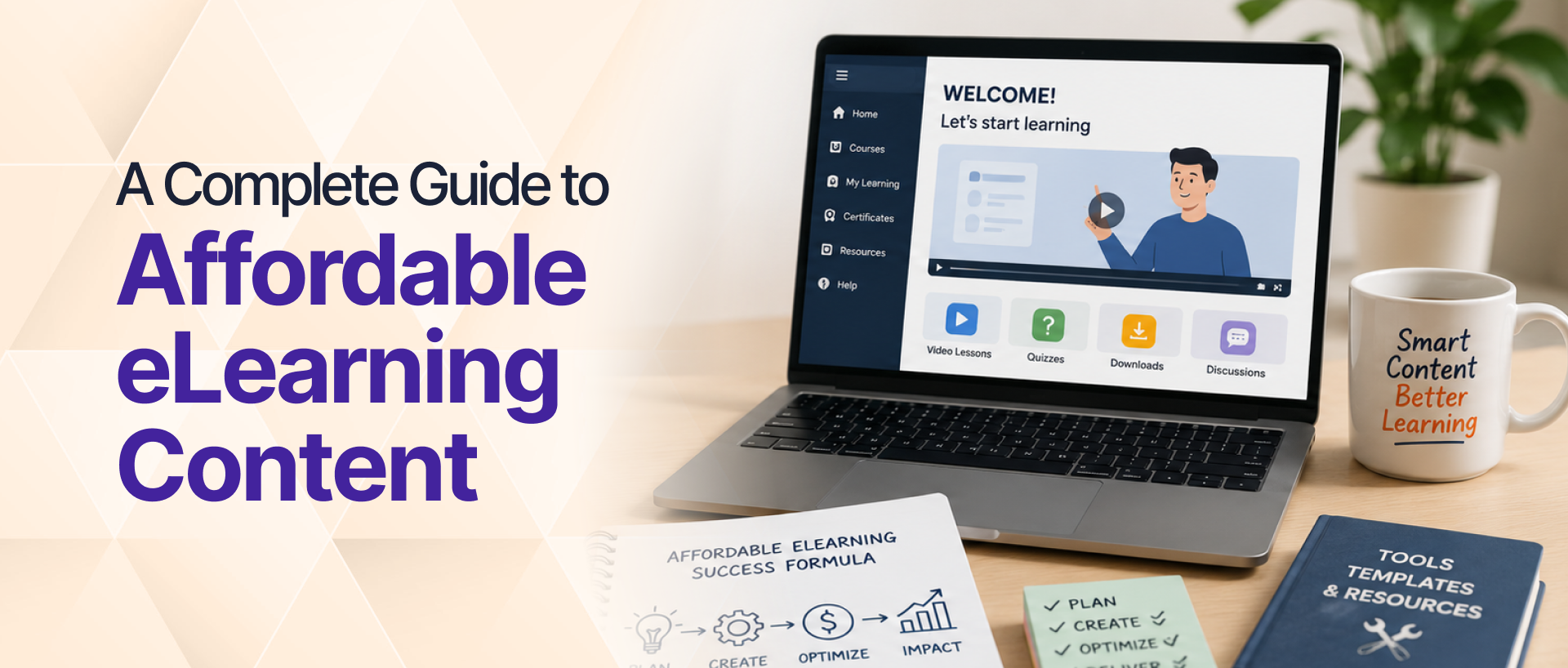
Many small businesses do not have a scheduled budget for training their team, but this is costing them in million-dollar losses, and they do not even know about it. When a workforce is not well trained to specialise in their roles, it shows in their sales pitches and communication, which makes major clients doubt the vendor's credibility, and the chances of securing projects from major companies decrease drastically.
To help such conditions, the businesses have to adopt effective training. The low-budget aspect limits their options in quality training, but if the smaller companies plan out the complete process wisely, the outcomes can be more impressive than expensive training. Affordable eLearning solutions are one of the examples of this.
As per the Brandon Hall Group, the companies save 50% - 70% on training costs by switching to eLearning content providers, and this also shows a positive impact on reducing training time by 40% - 60%.
The affordable eLearning services can help the workforce in sustaining a good-quality training course that helps the business grow with a minimum budget, and the impact of training will also show in client meetings, industry workshops, and the overall impression of the company.
These aspects make learning crucial in the workplace, and to adopt affordable learning content, one needs viable information on the topic. This article will help readers understand the complete process for creating affordable e-learning content.

This format of learning refers to eLearning services that are affordable for every organisation, whether they are multinational corporations or a startup, but this affordability does not mean compromising on the quality of learning content.
As per the user companies, their primary characteristics are lower cost per learner, scaling ability, reusability over a long period of time, and the ability to drive a measurable return on investment (ROI).
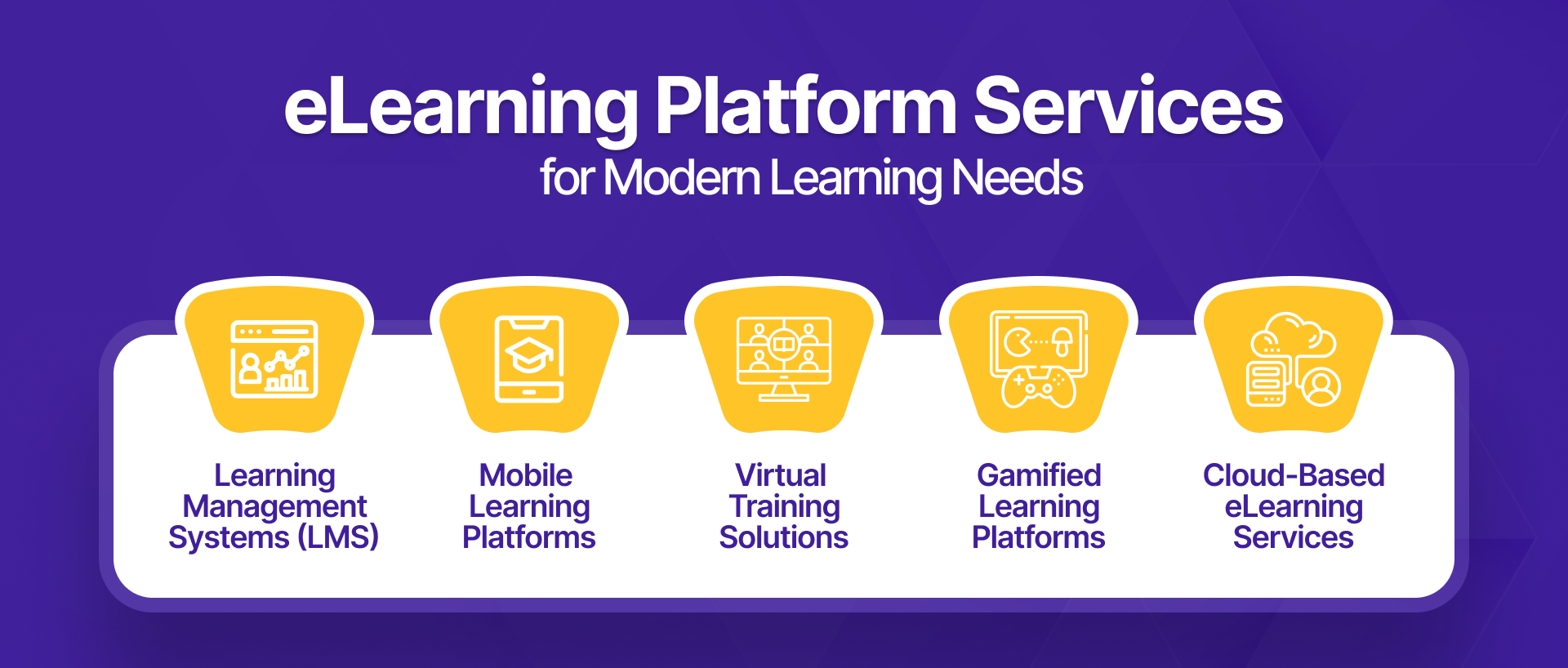
In this format, the organisation does not need to own any server to make this work. Everything runs on the service provider's server online. The customer just has to pay a monthly fee for the subscriptions on the platform, and along with hosting the course, the paid subscription offers perks like all the needed updates will be done automatically as long as the membership is renewed.
The companies can use publicly available tools to create and host e-learning platform services. In this process, there is no need for a vendor. The complete procedure is done by community service, which can act as partial support. Here, the charging fees are only for hosting and making customisations in the content whenever the host decides to.
Mobile-operated eLearning solutions providers can be found in many forms because the complete training is available on the learner's mobile learning device, which makes the whole process flexible and efficient. This process allows learners to train themselves effortlessly and on a budget.
Mobile-enabled programs are also easy to update because they are mostly designed in modular formats, so at the time of updating, the singular module can go under the upgrade process while the rest of the content still serves its purpose.
Microlearning is in demand in modern workplaces; the procedures involve breaking down the content into shorter and more digestible sessions, which can be completed in a single sitting. There have been studies by eLearning service providers where the inclusion of micro-lectures drives a higher completion rate in learning.
The recent surge in demand for this has been because this is the only model that can adapt to new generation workers' low attention span criteria and help employees complete any form os training with minimal to no distractions.
These e-learning services are generic courses that are a perfect option for smaller businesses that want to limit their training or learning budget and want a good quality e-learning solutions provider for the onboarding process, compliance training, and similar learning.
In this format, the content is mostly backed by industry experts at e-learning content providers, so the chances of failures are low compared to other formats.
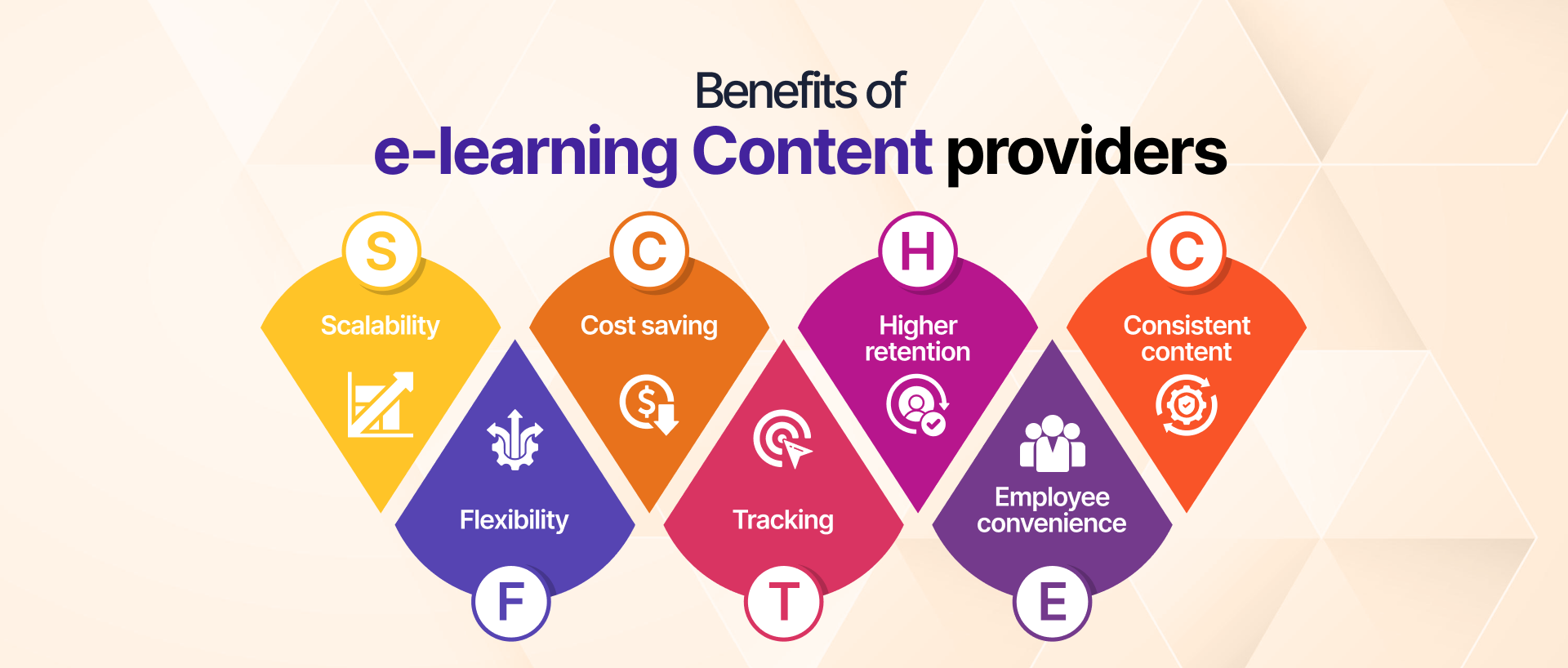
The e Learning platform development is done with the purpose of scaling the content across hundreds or even thousands of workers simultaneously. The organisations can adjust their properties based on their criteria over different periods of time.
The industry prefers scalable content more often because this has a very low running cost in the long run, and they can launch the training quickly and efficiently as per new market changes.
Affordable eLearning solutions are highly flexible. The learners can complete their sessions everywhere, whether we talk about being in the field while working or taking a refresher session in between meeting breaks; the system is supportive regardless.
If the eLearning platform services do not make training flexible and self-paced for learning, there are high chances that trainees will drop the training or will not retain the needed information, and to be honest, that will ruin the whole purpose of training.
As the word suggests, this method of training is cost-saving without compromising the quality of content. And the reasons that make it so affordable are not only digital delivery or a certain type of content selection.
The real phenomenon is that this reduces the cost per learner, requires no travelling, which means no travel expenses, reduces instructor cost, which is usually very high in traditional learning formats, and the organisation does not have to spend on flights, a venue, and a hotel room only to hold one-day workshop-like training sessions while learners cut working hours to attend the workshop.
Imagine a learner having been in years-long training to master some industry-specific skills. And when they complete that, but their knowledge is not proven to be improved, guess the reason behind this.
The reason is that he only focused on the content part of e-learning services, not the assessment and quiz options. And learning means nothing with its test. If the organisation does not track their learners to check their improvements and errors, eventually the workers will complete the course without realising whether this format is aligned with their specific goals or not. Here begins a cycle of learning that has no results.
The eLearning platforms are designed to serve the purpose of attaining higher knowledge absorption rates in employees. It has also been acknowledged that around 94% of workers stay in a company longer if they provide training that can help in learning the needed skills and help them develop while being relevant in the market.
The training is scheduled to be completed by the employees; that is why it not only benefits companies but also the people who do the major work. This attribute of training has increased the worker satisfaction and completion rates with one aim.
The eLearning providers issue various elements to make it a more engaging experience for employees, such as off-site learning, self-paced learning, market-relevant skills, practice in a safe environment, and instant feedback from the server.
The eLearning platform services are developed to provide the same high-quality learning content to everyone, whether they are special-abled, remote workers, university students, or someone sitting on the other side of the world.
Affordable eLearning solutions are mostly used for compliance training and the onboarding processes, and each employee must receive the same knowledge on the topic. That is why the content is translated to support diverse working groups and has standard messaging across the organisation.
For building any learning or training program, it is not necessary that organisations must buy everything new; they can purchase off-the-shelf courses that focus on specific skills like soft skills and cybersecurity. And save the budget for content that actually deserves it, like company-focused training programs.
Start by estimating the cost of producing eLearning platforms services, and calculate the salary of workers, the fee of tools needed, and the cost of implementing the technology. Now, based on your preferences and budget, consider whether you could afford a good vendor that can provide expertise in complete infrastructure.
It will be beneficial to build modular eLearning services from the start of the development. This will allow the learning and development team to reuse the same module across different training courses. A 5 - 8 minute-long video that explains company policies will be needed for the upcoming years, and the same applies to other modular parts of the program.
Define all the important metrics before building and defining e learning platform development because that is necessary for measuring the capability of the training program. Consider business goals, return on investment, improvement criteria, and the progress percentage of the company.
Then, after the deployment, compare all the stats and improvements to previous data and create an analytic report to calculate real outcomes.
Ask your e-learning content providers for a mobile-accessible program, which will increase the completion rate because most of the learners prefer to learn on their handheld devices rather than a desktop. Use interactive and touch-responsive designs with offline access. This will save the cost of computer setups while targeting the complete workforce.
Implementing a new training program and discarding the previous one is definitely a difficult process due to the obvious reasons.
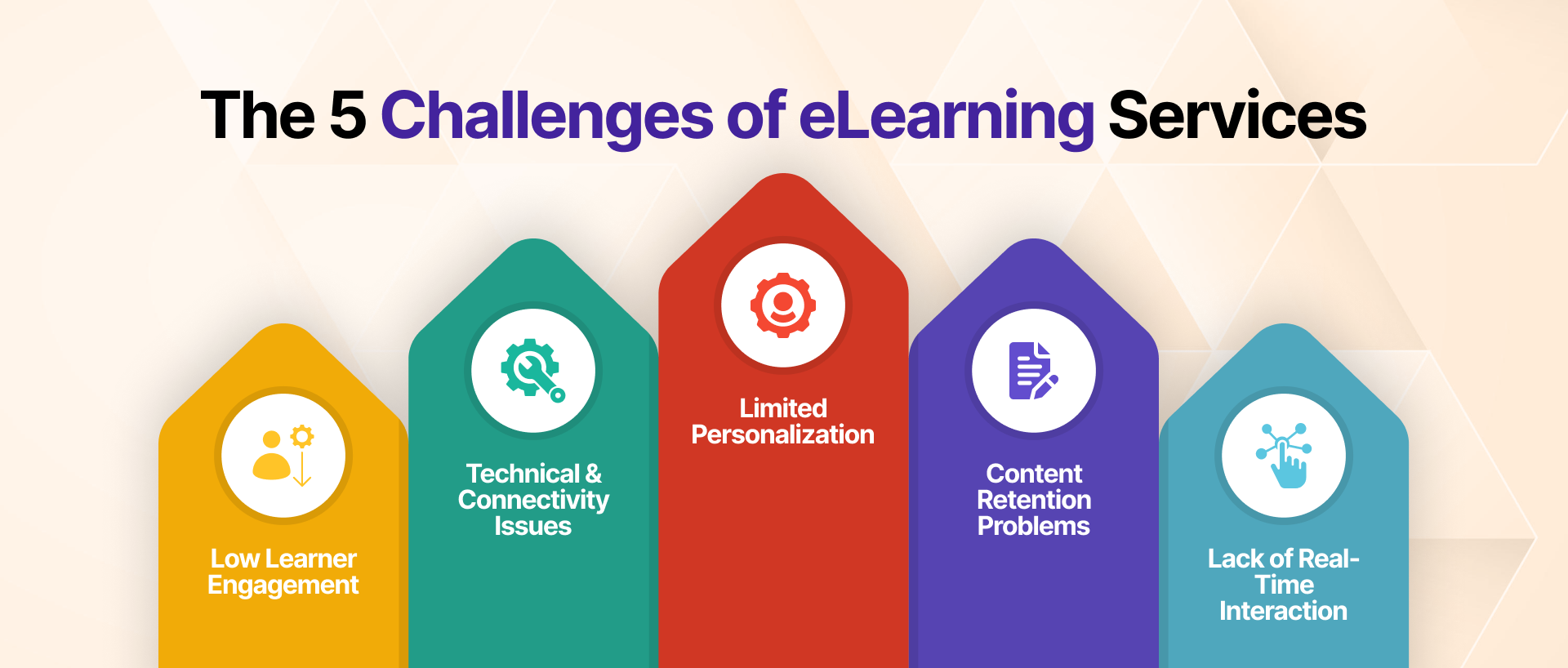
Sometimes the organisations invest heavily in the eLearning platform services, but when they check for the analytic results, they come out below expectations, even after spending a significantly high budget; it is a common problem in digital training courses. This makes the L&D team frustrated and desperate, which leads to drastic cost-cutting of the project, but in the end, the organisation is still stuck with inefficient training and workers who need training.
After getting familiar with traditional or similar training methods, shifting to eLearning solutions providers can feel like a sudden and unwanted change to learners. They might refuse to engage with the training content, which could be due to various reasons like fear of technology, lack of confidence, and fear of job security.
A huge part of organisations struggle to measure the effectiveness of eLearning platforms, but they are important for the return on investment (ROI). The authorities ask for learning outcomes and about the employee growth after this program, but it is really difficult to measure the growth of workers from the training and determine their work costs
Affordable eLearning solutions do not have any predetermined budget to update the content on time, and the process of updating also requires inputs from the L&D team, making the process more critical. That is, the content expires before the employees can utilise it completely in their favour. At last, the complete training goes in vain because learning from an uncredible program can do more harm than good.
When a company receives eLearning content services in English, but when they need to train a culturally diverse group of employees, they do not want to invest in a good-quality and expensive translation service and resort to some cheap AI voice, then the learner from a different culture finds the training language tacky, and the completion rate decreases. And the course needs major updates to run again, demolishing the whole purpose of affordable learning.
Read more: Blended Learning Solutions for Compliance Training
Whether to build, buy, or partner for the training program, a company will always have to use its own inputs for developing the program, and that is not a point that detracts from the training but is a step to potentially personalise the content for the team.
Affordable eLearning solutions allow every business a chance to grow, whether they are big corporations, small businesses, or even startups. Adopting eLearning platform services from the beginning will develop a highly competitive team by the time the business starts to compete with major organisations in the industry. Giving the business a competitive advantage regardless of its size. You want to know more, you can contact Acadecraft today!
Share
Acadecraft has been an invaluable partner in our journey towards excellence in certification. Their commitment to delivering exceptional service, coupled with their unwavering dedication to timeliness and quality, has truly set them apart.
From the outset, their team has demonstrated a keen understanding of our needs, consistently delivering reports with meticulous attention to detail. Their responsiveness is commendable; whenever we've reached out with queries or requests, they've always been prompt and accommodating, ensuring a smooth and seamless experience.
One of the standout aspects of Acadecraft's service is their ability to deliver reports in a timely manner without compromising on quality. This has been instrumental in our decision-making processes, allowing us to make informed choices based on accurate and insightful data.
Acadecraft has consistently exceeded our expectations with their exemplary service, timely responsiveness, and unwavering commitment to quality.

Acadecraft's Voice-Over service was amazing! The team provided accurate and culturally relevant recordings for what we expected. They showed true professionalism and expertise. We highly recommend Acadecraft for their excellent Voiceover services.

Always impressed with Acadecraft's expertise! Their translation services play a vital role for our company to drive international growth within our team and clients.

AcadeCraft's assessment content creation team was able to understand our unique requirements and created customized assessments that fit our needs. The team was prompt and professional, and the quality of their work was good.

Acadecraft have recorded several audiobooks for us. They have a wide range of talented artists with different accents who really bring our stories to life. Their work is of high quality, with good attention to detail.
Acadecraft are reliable, efficient and friendly. Their services are highly recommended by us.

As a producer, I've had the pleasure of using Acadecraft for sourcing VO and liaising with artists for several film projects. They offer a wide range of VO profiles and the artists I have collaborated with all were talented and professional. The team at Acadecraft have supported me with great professionalism, responsiveness and creativity. I highly recommend their services.

Acadecraft has been helpful with connecting our editorial team with subject matter experts (SMEs) who help us QA assessments and create solutions for computational assessments. They have been able to find SMEs to meet our needs and our deadlines. We are happy to continue to partner with Acadecraft.

Acadecraft team is always very supportive, and we and Acadecraft corroborate to create educational contents for K12 Students in India.
We appreciate Acadecraft teams' professionality, punctuality, creation skills in each subject.

I am thrilled to share my testimonial for Acadecraft which creates interactive and engaging content. Working with this team has been an absolute pleasure from start to finish. Not only did they create outstanding content for our project, but they also went above and beyond to ensure that it was interactive, engaging, and effective.
Throughout the entire process, the team was highly cooperative and communicative, always available to resolve any issues or concerns that arose. They truly made us feel like partners in the project, and their dedication to delivering high-quality content was evident in every interaction.
Thanks to their exceptional work, our project was a huge success, and we couldn't be happier with the results. I highly recommend them to anyone looking for a team that is passionate, professional, and committed to excellence. Wishing them all the best in their future endeavors.

The team at Acadecraft has truly been an end-to-end service provider for us, providing content development services and their commitment, attention to detail and expertise have made the project a success. Their team's dedication, attention to detail, and expertise have been unmatched, making our partnership an absolute pleasure. We highly recommend Acadecraft to anyone looking for a reliable and efficient education solutions provider.

Our experience working with Acadecraft has been great. Their highly knowledgeable team of experts was always available to answer our questions, provide guidance, and ensure we were delighted with the services. Their thorough, accurate assessments provided valuable insights that helped us make informed decisions about our exam performances.
We look forward to continuing our partnership with Acadecraft and leveraging their expertise to help us achieve our business goals.

I recently used Acadecraft's Video Editing services and I am extremely impressed with the quality of their work. The team at Acadecraft was highly professional, attentive and skilled in delivering my company’s project on time and within budget.
Their attention to detail was impeccable, and they understood my needs and requirements very well. They were able to create a video that not only met my expectations, but far exceeded them.
Throughout the process, they kept me informed and updated on the progress of the project, and were always available to answer any questions I had. Their customer service was excellent, and they were always friendly and easy to work with.
I highly recommend Acadecraft's Video Editing services to anyone who is looking for a high-quality and professional video editing experience. They are truly experts in their field and I look forward to working with them again in the future.

The video creation team of Acadecraft is insightful. They understood my requirements carefully and delivered a winning video that perfectly aligned with my business needs.
With a good script, content, sound, and editing – Acadecraft helped me with the best video content to strategize my marketing and promotional campaigns. Their tremendous experience in video editing and professionalism in serving the customer before and after delivering services are commendable.
The passionate team knows great about getting into the details and providing impeccable video services. I am extremely impressed by the work Acadecraft has delivered to me.
I appreciate my collaboration with Acadecraft and look forward to availing of services again.

I required an explainer video for my business, and I am mesmerized by the work Acadecraft’s video editing team delivered to me. The perfectly aligned video elements and superb editing demonstrate the experience, knowledge, and professionalism Acadecraft has.
Acadecraft’s 3d video solutions are amazing. They used a perfect blend of art, color, shape, sound, and editing to create the video, making the video engaging and immersive.
I have always been excited to explore the opportunities of videos in business, and it was my pleasure to make Acadecraft my companion for the best video solutions. I highly recommend this organization and would love to collaborate with them again.

With a holistic approach to creating powerful blended videos, Acadecraft delivered me a well-developed video solution. I appreciate the relentless efforts of the video editing team, whose in-depth knowledge and analytical skills effectively catered to my needs.
The services Acadecraft has given me exceeded my expectations; the team was effective and listened to my requirements carefully, and went the extra mile in researching and creatively developing awesome pieces of video content.
Not only from a quality perspective but on the management and delivery front, Acadecraft’s services are prolific. They stuck to the turnaround time and were constantly in touch with me throughout the creation process.
I recommend Acadecraft for video solutions as they have great hands-on use of animation, graphics, and other creative assets.

I am thoroughly astounded by Acadecraft's proficient skills! Their exceptional voiceover and translation services were instrumental in amplifying our marketing endeavors and video promotions. They enabled us to communicate effectively with varied audiences and significantly propelled growth across numerous media platforms.

Working along with Acadecraft has been an exceptional journey. Their meticulous attention to detail and commitment to maintaining the essence of the content in the transition from English to Arabic was truly impressive. The collaborative spirit and timely communication made the entire process smooth and enjoyable. Without a doubt, I wholeheartedly endorse their services for a remarkable translation experience.

I am delighted to share my feedback with you on working on the editing and print layout of 9 documents under the KECF project. Overall, I am very happy with the speed with which these documents were edited and the fine attention to details. I also deeply appreciate the quick corrections that were made on our request. Particularly, working with Sanjana was a real pleasure, as I found her very attentive to our requests and her internal quality checks before she sent the documents to us greatly reduced my workload. So many thanks Sanjana! I look forward to working with your agency if such a need arises in future too. Many thanks to Sanjana and your entire team.
I am pleased to share that Acadecraft has demonstrated an excellent understanding of our Operations processes, ensuring a smooth and efficient knowledge transfer. The team, including the project coordinators, is highly responsive and addresses any concerns swiftly leading to effective resolutions and seamless delivery.

With our continued global expansion and projects- it was necessary that we join in partnership with Acadecraft. As they have assisted us in increasing production value in all sectors of our company; providing great infrastructure with top professionals. Acadecraft represents efficiency to execution to many of our projects and initiatives with a standard of excellence unmatched.