 By:
Marilyn Schenk
By:
Marilyn Schenk 
Organisations are investing heavily in learning solutions, yet performance metrics aren’t improving at the same pace. This growing disconnection is prompting leaders to revisit whether corporate learning solutions truly support modern business complexities or not.
If corporate learning solutions are failing the business, what could be a replacement worth the long-term investment? To unveil, there is a popular term emerging called ‘custom e-learning solution’ that is upskilling employees to define the modern business arch.
According to Technavio, it is found that the ‘e-learning market size is expected to grow by USD 326.9 billion, with a compound annual growth rate (CAGR) of 18.9% from 2024 to 2029.’
E-learning solutions are capturing the market at an unprecedented pace. But the real question is, are businesses simply upgrading to these digital training solutions, or are they investing in solutions that genuinely drive workforce performance? As organisations rethink the effectiveness of traditional corporate learning solutions, it becomes essential to evaluate what truly delivers measurable impact. This blog explores that strategic shift.
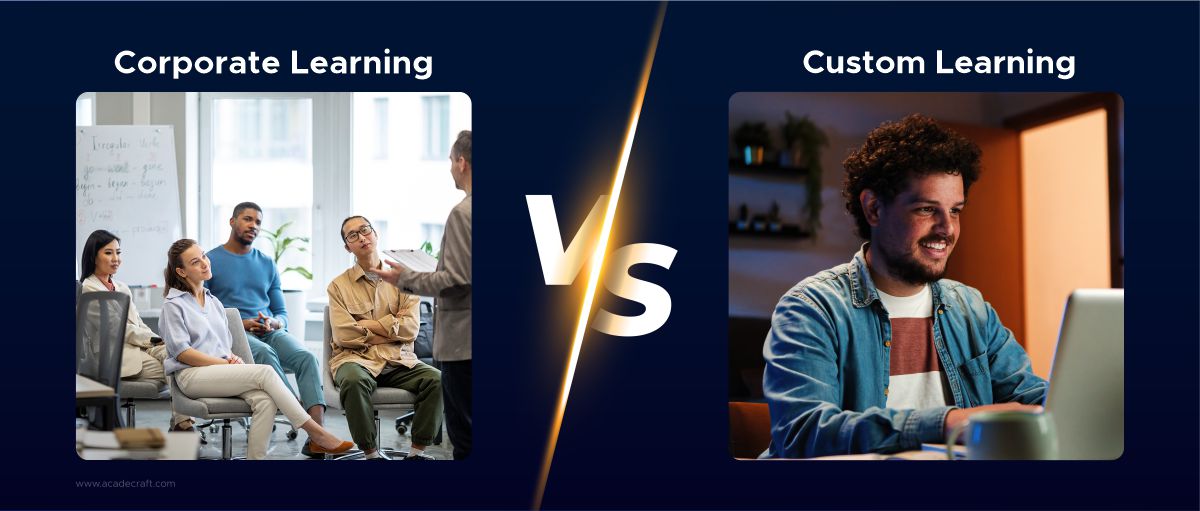
Both are corporate learning solutions that educate and train employees in a structured manner. These solutions are designed to deliver scalable, standardised development across departments. They highly focus on compliance, onboarding, leadership development, and skill enhancement programs.
The corporate learning solutions are structured, organised, and wide training programs designed for employees to improve their skills. These are off-the-shelf learning solutions that work equally for a wide range of industries.
Organisations need to provide three types of training, which include onboarding and compliance training, and leadership development programs. The training solutions are provided through various standard methods, which include LMS platforms, workshops, and eLearning modules to achieve uniformity and workforce training expansion.
The custom e-corporate learning solutions are training programs specifically designed for unique challenges and performance gaps. Unlike standardised training, these solutions are built after analysing the company’s objectives, role, requirements, and operational needs.
They held a targeted skill development program that directly supports measurable outcomes and strategic growth.
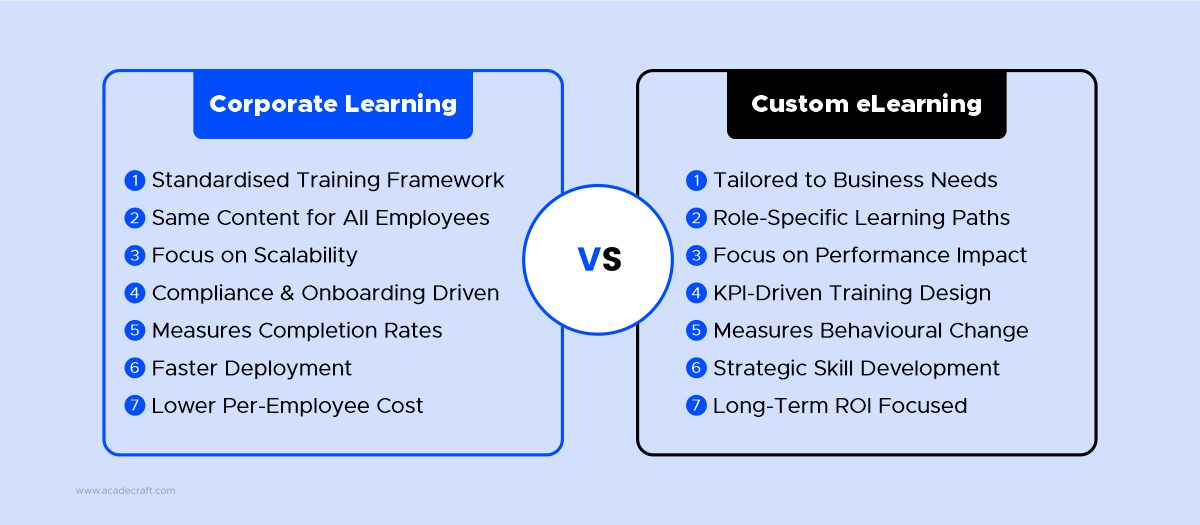
Below, we’ve crafted a table where the key differences between corporate learning and custom learning are highlighted precisely.
Both address the same problem, but the methodologies differ. One helps at the surface level, whereas the other helps with precision.
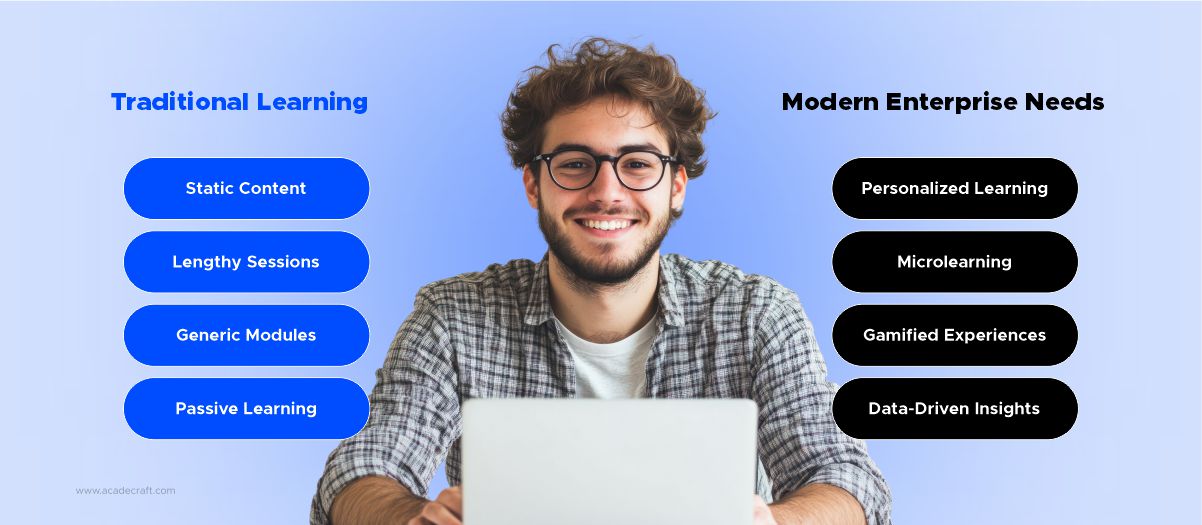
The corporate learning solutions provide a wide range of training programs designed to develop employees' skills. As digitalisation overtakes and AI automations sideline traditional approaches.
1. One-size-fits-all Solutions
The traditional learning frameworks are designed for mass deployment. These solutions ensure consistency but often fail to highlight specific challenges. These challenges vary depending on competency level and the role-based skill required. Modern business requires precise learning, while generalised content does not meet its needs
2. Poor Alignment with Business Performance Metrics
Traditional corporate learning programs are focused on completion rates and attendance rather than measurable business outcomes. The organisation does not create connections between its initiatives and key performance indicators, which include productivity and revenue growth
. This leads to training becoming a routine exercise rather than a strategic driver.
3. Slow Adaptation Rate to Market Disruption
The rapid evolution of industries occurs because digital transformation, automation, and changing consumer behaviour shape business operations. Corporate learning solutions lack flexibility because they cannot update their training materials during learning sessions. The learning process extends throughout the entire organisation.
4. Overemphasis on Compliance Over Capability
The primary focus of corporate learning services is to deliver essential compliance training programs. The excessive emphasis on regulatory modules provides essential knowledge to employees. Though it creates a barrier that prevents employees from developing skills essential for driving innovation and becoming effective leaders.
5. Limited Personalisation and Learner Engagement
Nowadays, the workforce demands training programs which provide personalised content, interactive tools, and adaptable learning pathways. The entire organisation participates in the process of learning, which continues without interruption. The combination of static presentations with lecture-based teaching methods results in ineffective outcomes because students lack engagement, which leads to memory loss
6. Knowledge Delivery Without Behavioural Integration
The delivery of information cannot create alterations in human behaviour. Traditional training models lack essential elements because they do not include reinforcement systems, coaching methodologies, and real-time performance evaluation systems, which would enhance training results.
7. Scalability Over Precision
The learning process through traditional corporate training methods operates effectively when delivered to large groups. The practice of expanding operations without connecting to fundamental business functions leads to established systems that lack productivity. Modern organisations now focus on developing specific skills that match individual job requirements instead of providing general training programs to all employees.
Nowadays, modern businesses don’t consider corporate training a supportive function but the performing engine. These custom eLearning solutions develop specific business requirements, workforce deficiencies, and performance benchmarks.
These eLearning become a competitive advantage when education activities operationally match with the business targets of the organisations.
Let’s understand how custom learning drives real business impact:
1. Direct Alignment with Business KPIs
The custom e-learning solutions are designed after analysing organisational objectives, goals, and specific competencies. These corporate training solutions are linked to measurable KPIs that organisations use to assess their progress in revenue growth, operational efficiency, customer satisfaction, and innovation.
The organisation uses learning initiatives to support its business goals instead of treating them as separate human resources functions.
2. Role-Based and Skill-Specific Learning Paths
Traditional custom training solutions use standard training modules for all teams, whereas custom solutions create specific learning paths tailored to job functions, employee experience, and professional needs.
The sales teams receive custom corporate training that optimises their ability to increase sales. While managers develop their leadership, technical teams build skills. The accuracy of the content leads to higher relevance, better retention, and more practical use of knowledge.
3. Faster Adaptation to Market and Technology Changes
Industries are experiencing a fast transformation due to AI automation and digitalisation. These custom e-learning solutions allow enterprises to update training content quickly, ensuring employees remain updated with market trends and technological developments.
The agility of organisational systems enables organisations to protect themselves against future challenges while maintaining their operational capacity.
4. Improved Employee Engagement and Knowledge Retention
Engagement drives effectiveness. Customise e learning solutions incorporates interactive learning, gamification elements, and simulation technology. Combining these elements and educational material, employees are enabled to retain the knowledge effectively.
5. Enhanced Productivity and Operational Efficiency
The corporate training solutions become simple when employees get instruction that matches their work needs. The workforce productivity increases through several factors, which include reduced errors, faster task completion, improved collaboration, and better decision-making. Through these organisations, achieve better profitability and stronger organisational performance.
6. Measurable ROI and Data-Driven Insights
The process of modern corporate online training design requires analytical dashboards and performance monitoring systems as essential components. The organisation uses three assessment methods to measure training progress. The system tracks completion rates while measuring skill development and monitoring employee behaviour changes, which impact business results. The organisation uses data-based visibility to help employees enhance their learning methods through continuous evaluation.
7. Stronger Competitive Positioning
The ability to attract and retain skilled employees establishes a unique market position for companies that compete in fast-paced business environments.
Custom corporate learning solutions enable organisations to develop unique skill sets aligned with strategic vision. The company needs to develop specialised knowledge that will enable it to exceed current industry requirements.
Organisations that need precise learning solutions with strategic ties should select corporate learning services because they offer more effective results. Structured learning programs that follow established standards and procedures deliver better results for organisations that need to control costs while growing their operations.
Organisations need to deliver identical training programs whenever they hire multiple employees or enter new markets. Corporate training solutions ensure that every employee receives the same foundational knowledge about company policies, systems, culture, and operational procedures.
Healthcare, finance, manufacturing, and IT fields need to follow strict rules that their respective industries enforce. The corporate learning services deliver standardised compliance modules which enable organisations to follow legal requirements and industry standards. Organisations need to maintain consistent training delivery because structured programs help minimise training-related risks.
Developing custom programs requires organisations to allocate funds for both research activities and instructional design and technology incorporation. Ready-to-deploy corporate training solutions provide businesses with budget constraints a cost-effective solution that meets their essential learning needs.
A structured corporate eLearning system provides adequate training for employees who need to learn company-wide processes, software systems, and standard operating procedures. Most training requirements do not need extensive customised solutions.
Also Read: Corporate Learning Management Systems (LMS) for Scalable Businesses
In the competitive business environment, employee training is a necessity, but providing them with bundles and lectures won’t help. In this regard, Acadecraft came to the rescue.
Acadecraft is a corporate elearning platform that provides custom e-learning solutions to keep your employees aligned with their desired roles. We provide solutions for improving business productivity, providing growth by optimising training programs
We identify skill gaps, departmental requirements, and strategic KPIs, and design targeted learning frameworks that address real performance bottlenecks.
Below, we’ve highlighted what our custom e-learning solutions aim to do
We understand where modern businesses are lacking and work on those bottlenecks to improve employee efficiencies.
Also Read: Corporate Learning vs Custom eLearning
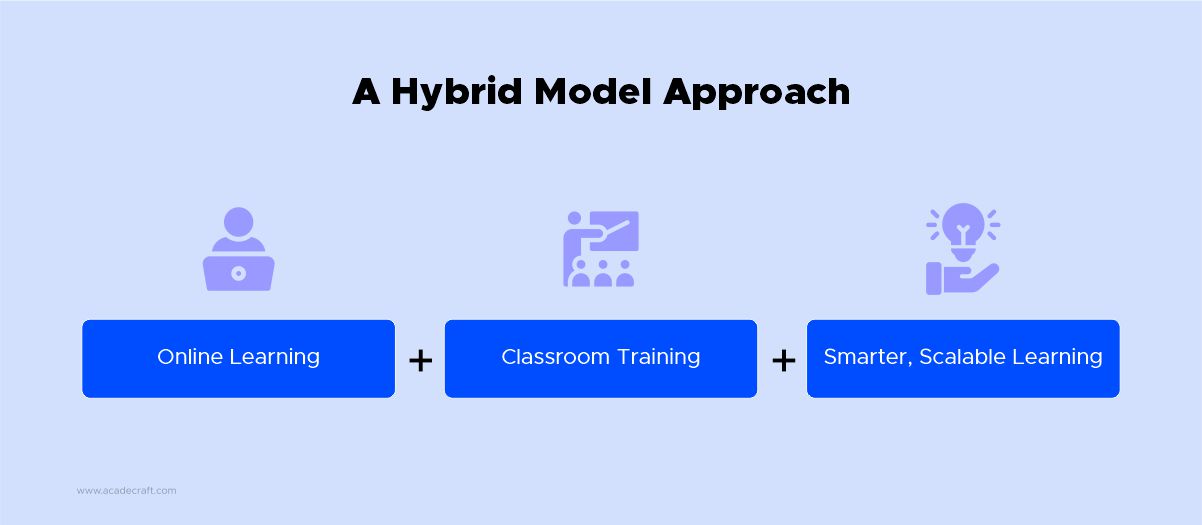
The current business environment requires organisations to create a balanced learning approach that combines their corporate learning program with their custom eLearning solution. Organisations that think ahead use hybrid learning systems because these systems provide corporate learning framework expansion and custom learning solution development.
Corporate learning programs deliver three main benefits through their structured approach, which maintains consistent operation while ensuring compliance with required standards. The program provides identical training for essential knowledge, corporate policies, and employee onboarding and legal training across all departments and locations. The process establishes essential patterns that create uniform operational processes throughout the organisation.
Business growth requires organisations to develop their standard operating procedures according to particular requirements. Organisations need special professional development programs that will create leadership skills, innovation abilities, and performance-based training. Organisations need custom learning solutions because these solutions address their specific requirements. The organisation achieves operational improvements by developing training materials that match specific job functions, departmental needs, and organisational goals.
Corporate learning solutions, through their basic implementation, create all essential elements which organisations need to handle employee onboarding, compliance education, system training, and corporate policy updates. The programs achieve three main business objectives through their operational processes, which generate efficient results while maintaining cost control and establishing uniformity throughout their operations.
Custom eLearning programs develop specific skills that users need to achieve their performance goals. Sales enablement programs, together with digital transformation training, leadership acceleration tracks, and role-specific technical development programs, create direct connections to business key performance indicators.
Also Read: The 7 Best Advanced Authoring tools for corporate eLearning Development
Business priorities determine which training options organisations select between corporate learning solutions and custom e-learning solutions. Corporate online training, together with a corporate e-learning platform, delivers systematic training programs that can expand their reach while maintaining their training standards. The training programs operate successfully for three purposes, which include onboarding people and ensuring compliance and training large workforces who require standardised training at a cost-effective rate.
Today's businesses function within environments that experience continuous changes because of digital transformation, artificial intelligence, and shifting customer demands. The use of standard corporate training programs does not lead to actual performance improvement when companies operate in these specific situations. The organisation needs tailored e-learning solutions which connect their learning programs to both their key performance indicators, their required job skills, and their future business goals.
Corporate learning services create the fundamental structure. Custom solutions create special advantages for businesses.
The best way for progressive organisations to move forward requires them to use both methods together. The hybrid model uses corporate online learning, which can be expanded to deliver basic training needs while using custom training programs to enhance innovation capabilities, leadership skills, and productivity results. You want to know more, you can contact Acadecraft today!
Share
Acadecraft has been an invaluable partner in our journey towards excellence in certification. Their commitment to delivering exceptional service, coupled with their unwavering dedication to timeliness and quality, has truly set them apart.
From the outset, their team has demonstrated a keen understanding of our needs, consistently delivering reports with meticulous attention to detail. Their responsiveness is commendable; whenever we've reached out with queries or requests, they've always been prompt and accommodating, ensuring a smooth and seamless experience.
One of the standout aspects of Acadecraft's service is their ability to deliver reports in a timely manner without compromising on quality. This has been instrumental in our decision-making processes, allowing us to make informed choices based on accurate and insightful data.
Acadecraft has consistently exceeded our expectations with their exemplary service, timely responsiveness, and unwavering commitment to quality.

Acadecraft's Voice-Over service was amazing! The team provided accurate and culturally relevant recordings for what we expected. They showed true professionalism and expertise. We highly recommend Acadecraft for their excellent Voiceover services.

Always impressed with Acadecraft's expertise! Their translation services play a vital role for our company to drive international growth within our team and clients.

AcadeCraft's assessment content creation team was able to understand our unique requirements and created customized assessments that fit our needs. The team was prompt and professional, and the quality of their work was good.

Acadecraft have recorded several audiobooks for us. They have a wide range of talented artists with different accents who really bring our stories to life. Their work is of high quality, with good attention to detail.
Acadecraft are reliable, efficient and friendly. Their services are highly recommended by us.

As a producer, I've had the pleasure of using Acadecraft for sourcing VO and liaising with artists for several film projects. They offer a wide range of VO profiles and the artists I have collaborated with all were talented and professional. The team at Acadecraft have supported me with great professionalism, responsiveness and creativity. I highly recommend their services.

Acadecraft has been helpful with connecting our editorial team with subject matter experts (SMEs) who help us QA assessments and create solutions for computational assessments. They have been able to find SMEs to meet our needs and our deadlines. We are happy to continue to partner with Acadecraft.

Acadecraft team is always very supportive, and we and Acadecraft corroborate to create educational contents for K12 Students in India.
We appreciate Acadecraft teams' professionality, punctuality, creation skills in each subject.

I am thrilled to share my testimonial for Acadecraft which creates interactive and engaging content. Working with this team has been an absolute pleasure from start to finish. Not only did they create outstanding content for our project, but they also went above and beyond to ensure that it was interactive, engaging, and effective.
Throughout the entire process, the team was highly cooperative and communicative, always available to resolve any issues or concerns that arose. They truly made us feel like partners in the project, and their dedication to delivering high-quality content was evident in every interaction.
Thanks to their exceptional work, our project was a huge success, and we couldn't be happier with the results. I highly recommend them to anyone looking for a team that is passionate, professional, and committed to excellence. Wishing them all the best in their future endeavors.

The team at Acadecraft has truly been an end-to-end service provider for us, providing content development services and their commitment, attention to detail and expertise have made the project a success. Their team's dedication, attention to detail, and expertise have been unmatched, making our partnership an absolute pleasure. We highly recommend Acadecraft to anyone looking for a reliable and efficient education solutions provider.

Our experience working with Acadecraft has been great. Their highly knowledgeable team of experts was always available to answer our questions, provide guidance, and ensure we were delighted with the services. Their thorough, accurate assessments provided valuable insights that helped us make informed decisions about our exam performances.
We look forward to continuing our partnership with Acadecraft and leveraging their expertise to help us achieve our business goals.

I recently used Acadecraft's Video Editing services and I am extremely impressed with the quality of their work. The team at Acadecraft was highly professional, attentive and skilled in delivering my company’s project on time and within budget.
Their attention to detail was impeccable, and they understood my needs and requirements very well. They were able to create a video that not only met my expectations, but far exceeded them.
Throughout the process, they kept me informed and updated on the progress of the project, and were always available to answer any questions I had. Their customer service was excellent, and they were always friendly and easy to work with.
I highly recommend Acadecraft's Video Editing services to anyone who is looking for a high-quality and professional video editing experience. They are truly experts in their field and I look forward to working with them again in the future.

The video creation team of Acadecraft is insightful. They understood my requirements carefully and delivered a winning video that perfectly aligned with my business needs.
With a good script, content, sound, and editing – Acadecraft helped me with the best video content to strategize my marketing and promotional campaigns. Their tremendous experience in video editing and professionalism in serving the customer before and after delivering services are commendable.
The passionate team knows great about getting into the details and providing impeccable video services. I am extremely impressed by the work Acadecraft has delivered to me.
I appreciate my collaboration with Acadecraft and look forward to availing of services again.

I required an explainer video for my business, and I am mesmerized by the work Acadecraft’s video editing team delivered to me. The perfectly aligned video elements and superb editing demonstrate the experience, knowledge, and professionalism Acadecraft has.
Acadecraft’s 3d video solutions are amazing. They used a perfect blend of art, color, shape, sound, and editing to create the video, making the video engaging and immersive.
I have always been excited to explore the opportunities of videos in business, and it was my pleasure to make Acadecraft my companion for the best video solutions. I highly recommend this organization and would love to collaborate with them again.
With a holistic approach to creating powerful blended videos, Acadecraft delivered me a well-developed video solution. I appreciate the relentless efforts of the video editing team, whose in-depth knowledge and analytical skills effectively catered to my needs.
The services Acadecraft has given me exceeded my expectations; the team was effective and listened to my requirements carefully, and went the extra mile in researching and creatively developing awesome pieces of video content.
Not only from a quality perspective but on the management and delivery front, Acadecraft’s services are prolific. They stuck to the turnaround time and were constantly in touch with me throughout the creation process.
I recommend Acadecraft for video solutions as they have great hands-on use of animation, graphics, and other creative assets.

I am thoroughly astounded by Acadecraft's proficient skills! Their exceptional voiceover and translation services were instrumental in amplifying our marketing endeavors and video promotions. They enabled us to communicate effectively with varied audiences and significantly propelled growth across numerous media platforms.

Working along with Acadecraft has been an exceptional journey. Their meticulous attention to detail and commitment to maintaining the essence of the content in the transition from English to Arabic was truly impressive. The collaborative spirit and timely communication made the entire process smooth and enjoyable. Without a doubt, I wholeheartedly endorse their services for a remarkable translation experience.

I am delighted to share my feedback with you on working on the editing and print layout of 9 documents under the KECF project. Overall, I am very happy with the speed with which these documents were edited and the fine attention to details. I also deeply appreciate the quick corrections that were made on our request. Particularly, working with Sanjana was a real pleasure, as I found her very attentive to our requests and her internal quality checks before she sent the documents to us greatly reduced my workload. So many thanks Sanjana! I look forward to working with your agency if such a need arises in future too. Many thanks to Sanjana and your entire team.
I am pleased to share that Acadecraft has demonstrated an excellent understanding of our Operations processes, ensuring a smooth and efficient knowledge transfer. The team, including the project coordinators, is highly responsive and addresses any concerns swiftly leading to effective resolutions and seamless delivery.

With our continued global expansion and projects- it was necessary that we join in partnership with Acadecraft. As they have assisted us in increasing production value in all sectors of our company; providing great infrastructure with top professionals. Acadecraft represents efficiency to execution to many of our projects and initiatives with a standard of excellence unmatched.