 By:
Marilyn Schenk
By:
Marilyn Schenk 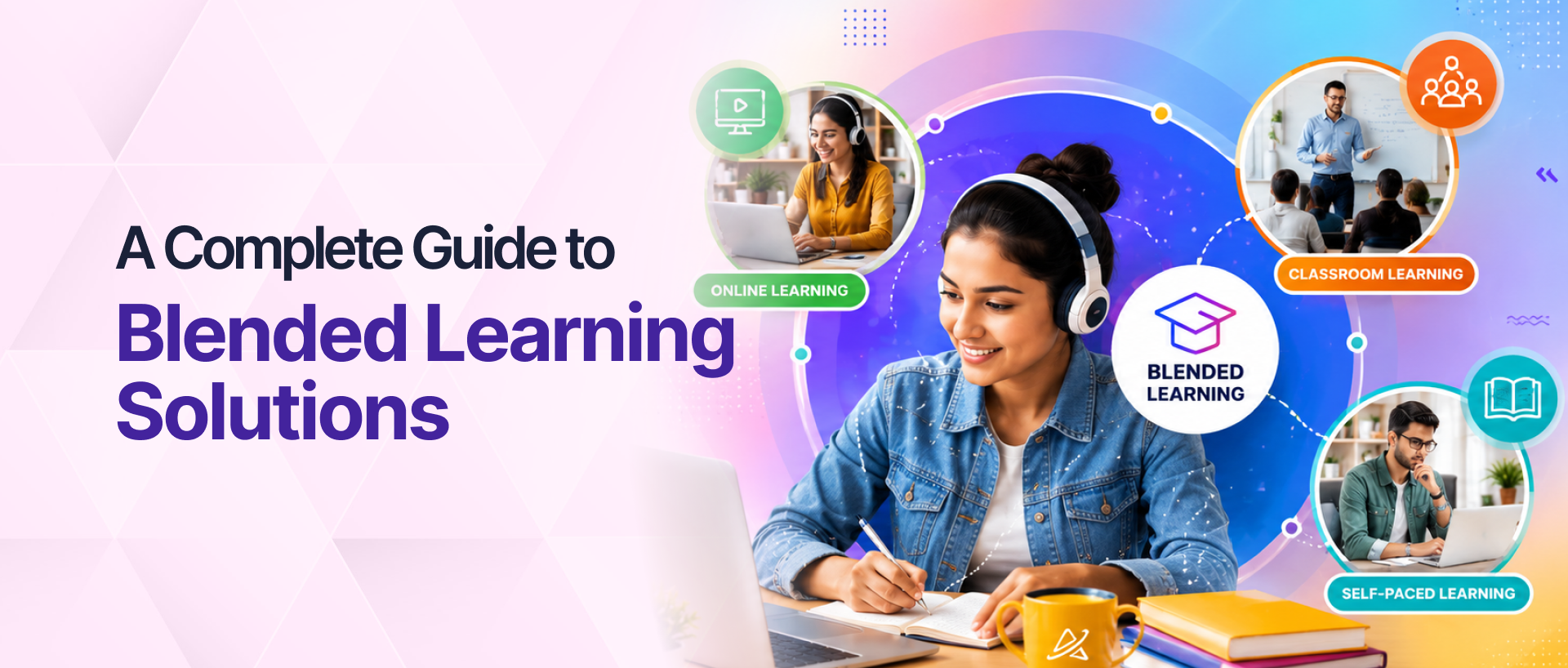
In these times, the new generation of learners expects the training to be flexible, self-paced, and digital by default because the modern world resonates with the best available technology that has digital parameters and makes learners realise the significance of human guidance and self-paced learning.
The organisations must grow accustomed to these changes, and adopting an online blended learning program can make the complete switch easier and transformative for those companies and their modern-day workforces.
According to the Brandon Hall Group, companies that use blended learning solutions and their strategies show 46% greater improvements than companies that only use instructor-led training.
This means the blended learning solutions industry is growing rapidly, based on some industry research. It can be expected that the blended learning market will be worth $37.51 billion. This will clearly define that the dual format of training is one of the most suitable methods for corporations.
Blended eLearning solutions are a learning method that includes the best of both worlds. Here, the learner can experience self-paced digital content and in-person or live classes with the instructor and peers. This format provides learners with flexibility, human guidance, and dual learning. These factors play a major role in higher retention and learner satisfaction rates.
A solution for blended learning is not adopted to exchange one format with another; instead, this allows learners to consume content at their own pace and seek guidance from the trainer when needed.
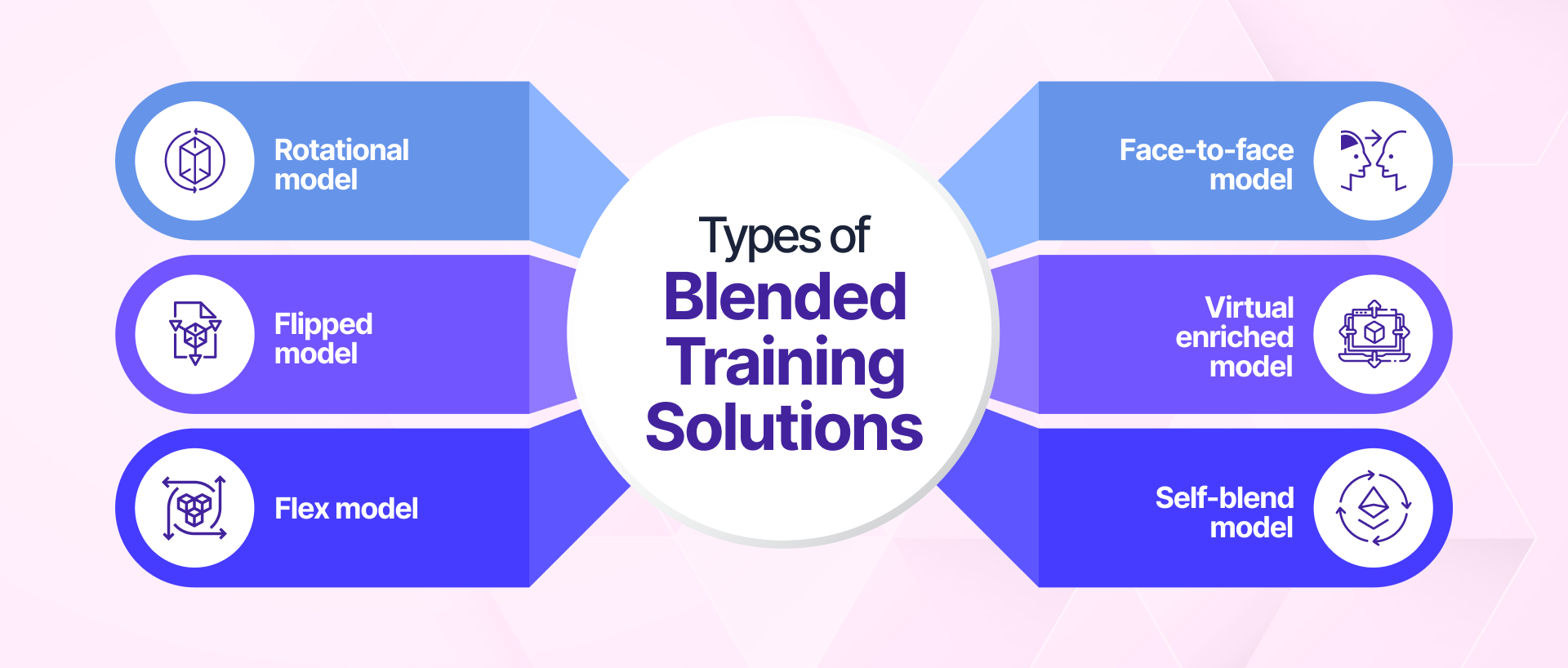
In this model, the learners are divided into two groups, where at different times each deals with a single aspect of learning, and then they switch. Like team A works on self-paced modules while team B is in-person classes, after completion, they switch.
This is the most used model in the modern world. Here, the learners first consume the basic self-paced content, and then in classes, the trainer and peers simultaneously apply what they learn. This is an ideal method for developing complex skills
This model is used mainly by self-disciplined learners. In this, learners show up in the classroom and then can complete the program by themselves and only reach out to the instructor when needed; otherwise, that is completely optional.
In this model of blended elearning solutions, the primary source of required knowledge is live classes with the presence of a trainer, while the self-paced content is treated as pre-learning material.
This model allows the learners to access the learning content remotely and complete most of their classes like this, but there are some occasional classes for discussion and practicals.
In this solution for blended learning, the learners focus on the main content first and then can willingly choose an additional program that helps them go deeper into a specific module. This format is often used by career-driven learners to develop a better skill set.
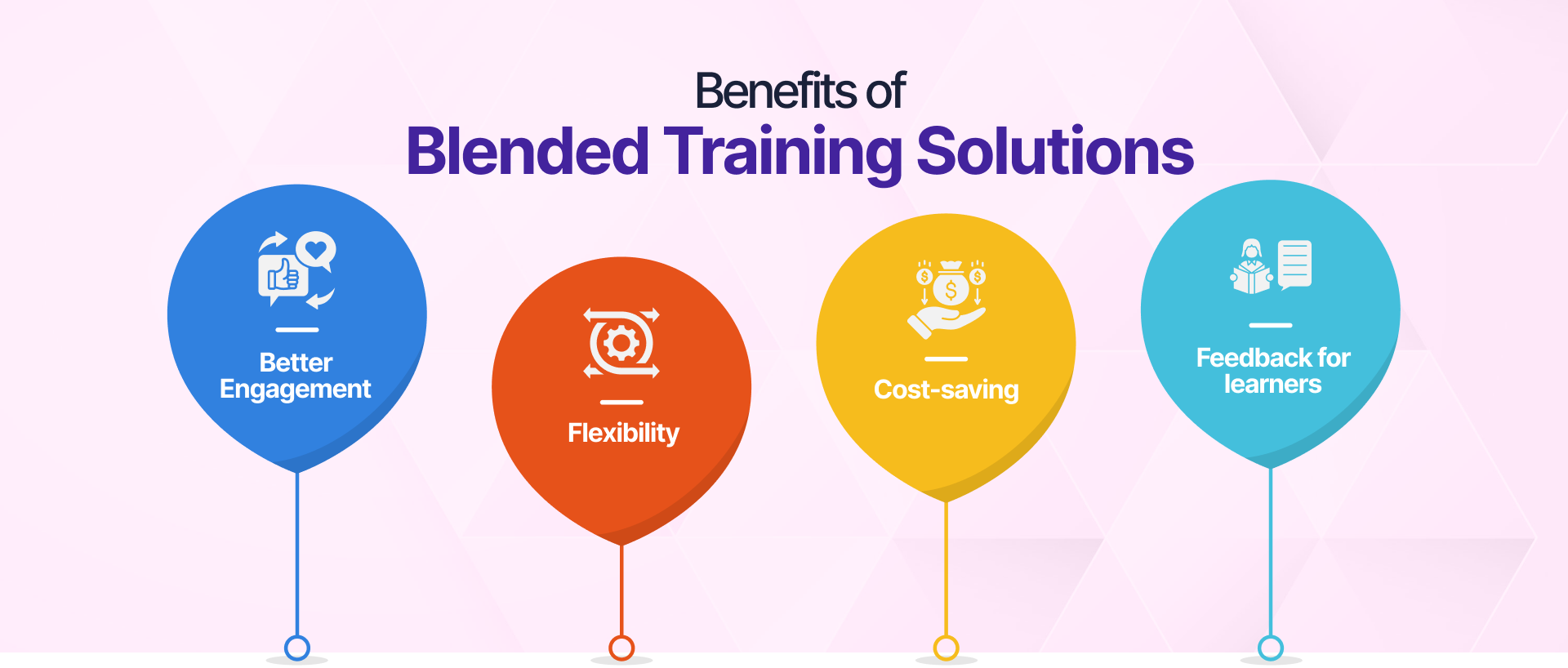
Blended learning platforms allow learners to switch between digital self-paced content and live classes with peers. This acts as a refresher from constant training, and students prefer this format over other methods that trap them in a monotonous environment. The variety of options here prevents learners from just skipping through modules due to digital fatigue.
The blended learning solutions support employees in self-paced training. Whether they want to pursue higher education while developing skills or continue their job alongside closing skills gaps, this method provides needed flexibility with trainer guidance. One can choose their trainer's presence to be occasional or constant based on the different models available.
The blended learning courses are significantly cost-saving in comparison with other programs that also provide instructor guidance. The reasons behind this saving is it does not require learners and trainers to travel for training, the organisations do not have to pay for a venue, and the content is digital, which saves printing material costs.
Also, the program is recorded, so it can be scaled, and when needed, it can be updated on the budget, which increases ROI and prevents any extra expenses.
The solution for blended learning facilitates live lectures, and the learners can receive instant feedback from their instructors. Which should be provided instantly, or else it will lose its significance, because if the learners receive their results of the test they completed a week ago by the present time, they will not even remember their faults, and the chances to fix those faults are down to nil.
In this method, nearly 68% of staff report that this training helps them maintain the balance between their personal life and work. This is because most of the learning is self-paced, and workers can catch a break instead of rescheduling to make time for class or something similar. Maintaining a healthy balance is also important because it gives employees a fresh start every day to carry out their tasks with creative and innovative thinking.
In modern workplaces, a single form of training cannot suffice for the training needs of employees, especially if they work in diverse organisations. Now, the employees need to have relevant content, quick, and efficient programs at their disposal, and blended learning platforms step up for exactly this cause.
If the organisation chooses either of the formats of digital self-paced content or traditional instructor-led sessions, then their training will not only be expensive, but also the learners would not favour conditions where they are not offered flexibility. Choosing blended learning would be beneficial for both the learners and the business.
From the beginning of the process, the learning objectives should be well defined, and along the way, technology should be chosen based on the same objective of success. For identifying learning objectives, start by defining the problems employees are facing, then write a suitable strategy needed for solutions, and be clear about the outcomes of training by the end of training.
To find a successful training model, one must understand its audience first. The learning and development team should conduct surveys across the team of learners and collect their preferences on the blended learning platform: about their preferred devices, format, challenge-facing abilities, comfort, and all of this should depend on their field of work.
Then choose from the available models: flipped classroom for complex skills, enriched virtual for remote teams, flex for self-educators, face-to-face for hands-on training, rotational for large groups, and self-blend for career development.
The content also needs to be divided into two sections, where one is a part to be studied by the students as self-paced content, and the other part will be decoded by the instructor in the class. The digital content should include foundational knowledge, product knowledge, compliance information, pre-work, and post-class content.
The in-person must include practice and application information, role play and simulations for better understanding, team discussion, Q&A sessions, and soft skill development.
If the learners have to change their platform to access the complete online blended learning program, then the chances that they are not able to retain most of the knowledge are high, while the learners are also troubled, which might lead to a drop in completion rates. To avoid getting in such situations, select the right stack of technology that allows learners to access the complete program at one LMS.
Make sure the chosen tech can handle online and offline aspects, is accessible on mobile, and can be integrated with existing business tools. The stack usually includes Adobe Creative, Zoom/Teams, Articulate, LMS services, and an analytical dashboard.
To develop the blended elearning solutions, begin by building learning content in modular form, design live class schedules, ensure consistent tone throughout the content, build relevant content relevant to the learners' needs, insert spaced retention, and confirm accessibility requirements with localisation options.
Now, for testing, gather 10 to 20 employees, create a pilot team and ask them to test the online blended learning program that the L&D created recently. Collect details from their learning about their feedback on the program, completion rates, engagement, user ease of technology, then measure the improvements with previous data, and in the final step, identify the errors of the program and fix them before further processing.
When launching the blended learning platform, the organisation should provide details of this training to team managers. Spread awareness on the need for training, allow managers to oversee learners' activities and progress, give them clear expectations with deadlines, and provide learners with technical support whenever needed. Manager participation will encourage teams to complete the training on time.
After the blended training solutions course is launched to the complete workforce, assign the L&D team to continuously track the learners in self-paced content and live classes, with assessment scores, knowledge retention, learner feedback, changes in business outcomes with training, and drop points.
This data will help compare employees' improvements in the long run. Hence, storing it is non-negotiable. Then, the learning and development team should update underperforming modules, reschedule the format based on results, and calculate ROI for the CEO and directors.
Read More: The Challenges and Strategies for Corporate Learning Services in 2026
Sales training requires human guidance because it is a complex skill, especially for newcomers, but the normal organisations cannot afford to follow traditional learning that includes flying in an expert, renting a venue, and having learners sit through a workshop where the experts talk about the needed skill. This format is irrelevant now.
When the organisation chooses blended training solutions, their workforce is able to access the content themselves, learn from the self-paced content and seek guidance of trainers when they need it.
A fintech company decided to train their complete workforce simultaneously with traditional instructor-led training, but the working team is too big to fit in an auditorium or class simultaneously.
The company can divide employees into two different groups of learners. Group 1 can be of freshers, and Group 2 can include experienced employees. Now, with a rotational model of solution for a blended learning program, both groups can manage to learn the same content by switching classes.
A retail company wants to train their new workers, whom they recently hired in multiple chains across the city, but the problem is the new hires are from different faraway regions, and getting them in one place specifically for training can be a tricky quest.
A blended learning platform allows those workers to learn about the needed skills remotely and practice them effectively with simulations and scenario-based studies, and treat the trainer guidance as an optional aspect of training. This format allows them to learn first and apply the knowledge at a job, and only in case of confusion, reach out for guidance.
Read More: A Complete Guide to Create Affordable eLearning Content
Blended learning solutions are the wave of digitalisation that is not new nor optional for the modern workplaces, but this is the default expectation for the learners due to the various factors thst includes social media content, digital accessibility, internet ease, and choosing the right vendor for this process can make the whole process smoother, enabling the organisation to achieve expected business outcomes
The organisations can choose the right model based on their employees' preferences and learning needs. The options vary for different formats and outcomes, which work for learners in many aspects. The program is beneficial for higher engagement, retention, and motivation.
The implementation of blended eLearning solutions is a strategic process of calculated steps and testing throughout the development process to make updates at various steps for learners and gain positive business outcomes.

Share
Acadecraft has been an invaluable partner in our journey towards excellence in certification. Their commitment to delivering exceptional service, coupled with their unwavering dedication to timeliness and quality, has truly set them apart.
From the outset, their team has demonstrated a keen understanding of our needs, consistently delivering reports with meticulous attention to detail. Their responsiveness is commendable; whenever we've reached out with queries or requests, they've always been prompt and accommodating, ensuring a smooth and seamless experience.
One of the standout aspects of Acadecraft's service is their ability to deliver reports in a timely manner without compromising on quality. This has been instrumental in our decision-making processes, allowing us to make informed choices based on accurate and insightful data.
Acadecraft has consistently exceeded our expectations with their exemplary service, timely responsiveness, and unwavering commitment to quality.

Acadecraft's Voice-Over service was amazing! The team provided accurate and culturally relevant recordings for what we expected. They showed true professionalism and expertise. We highly recommend Acadecraft for their excellent Voiceover services.

Always impressed with Acadecraft's expertise! Their translation services play a vital role for our company to drive international growth within our team and clients.

AcadeCraft's assessment content creation team was able to understand our unique requirements and created customized assessments that fit our needs. The team was prompt and professional, and the quality of their work was good.

Acadecraft have recorded several audiobooks for us. They have a wide range of talented artists with different accents who really bring our stories to life. Their work is of high quality, with good attention to detail.
Acadecraft are reliable, efficient and friendly. Their services are highly recommended by us.

As a producer, I've had the pleasure of using Acadecraft for sourcing VO and liaising with artists for several film projects. They offer a wide range of VO profiles and the artists I have collaborated with all were talented and professional. The team at Acadecraft have supported me with great professionalism, responsiveness and creativity. I highly recommend their services.

Acadecraft has been helpful with connecting our editorial team with subject matter experts (SMEs) who help us QA assessments and create solutions for computational assessments. They have been able to find SMEs to meet our needs and our deadlines. We are happy to continue to partner with Acadecraft.

Acadecraft team is always very supportive, and we and Acadecraft corroborate to create educational contents for K12 Students in India.
We appreciate Acadecraft teams' professionality, punctuality, creation skills in each subject.

I am thrilled to share my testimonial for Acadecraft which creates interactive and engaging content. Working with this team has been an absolute pleasure from start to finish. Not only did they create outstanding content for our project, but they also went above and beyond to ensure that it was interactive, engaging, and effective.
Throughout the entire process, the team was highly cooperative and communicative, always available to resolve any issues or concerns that arose. They truly made us feel like partners in the project, and their dedication to delivering high-quality content was evident in every interaction.
Thanks to their exceptional work, our project was a huge success, and we couldn't be happier with the results. I highly recommend them to anyone looking for a team that is passionate, professional, and committed to excellence. Wishing them all the best in their future endeavors.

The team at Acadecraft has truly been an end-to-end service provider for us, providing content development services and their commitment, attention to detail and expertise have made the project a success. Their team's dedication, attention to detail, and expertise have been unmatched, making our partnership an absolute pleasure. We highly recommend Acadecraft to anyone looking for a reliable and efficient education solutions provider.

Our experience working with Acadecraft has been great. Their highly knowledgeable team of experts was always available to answer our questions, provide guidance, and ensure we were delighted with the services. Their thorough, accurate assessments provided valuable insights that helped us make informed decisions about our exam performances.
We look forward to continuing our partnership with Acadecraft and leveraging their expertise to help us achieve our business goals.

I recently used Acadecraft's Video Editing services and I am extremely impressed with the quality of their work. The team at Acadecraft was highly professional, attentive and skilled in delivering my company’s project on time and within budget.
Their attention to detail was impeccable, and they understood my needs and requirements very well. They were able to create a video that not only met my expectations, but far exceeded them.
Throughout the process, they kept me informed and updated on the progress of the project, and were always available to answer any questions I had. Their customer service was excellent, and they were always friendly and easy to work with.
I highly recommend Acadecraft's Video Editing services to anyone who is looking for a high-quality and professional video editing experience. They are truly experts in their field and I look forward to working with them again in the future.

The video creation team of Acadecraft is insightful. They understood my requirements carefully and delivered a winning video that perfectly aligned with my business needs.
With a good script, content, sound, and editing – Acadecraft helped me with the best video content to strategize my marketing and promotional campaigns. Their tremendous experience in video editing and professionalism in serving the customer before and after delivering services are commendable.
The passionate team knows great about getting into the details and providing impeccable video services. I am extremely impressed by the work Acadecraft has delivered to me.
I appreciate my collaboration with Acadecraft and look forward to availing of services again.

I required an explainer video for my business, and I am mesmerized by the work Acadecraft’s video editing team delivered to me. The perfectly aligned video elements and superb editing demonstrate the experience, knowledge, and professionalism Acadecraft has.
Acadecraft’s 3d video solutions are amazing. They used a perfect blend of art, color, shape, sound, and editing to create the video, making the video engaging and immersive.
I have always been excited to explore the opportunities of videos in business, and it was my pleasure to make Acadecraft my companion for the best video solutions. I highly recommend this organization and would love to collaborate with them again.

With a holistic approach to creating powerful blended videos, Acadecraft delivered me a well-developed video solution. I appreciate the relentless efforts of the video editing team, whose in-depth knowledge and analytical skills effectively catered to my needs.
The services Acadecraft has given me exceeded my expectations; the team was effective and listened to my requirements carefully, and went the extra mile in researching and creatively developing awesome pieces of video content.
Not only from a quality perspective but on the management and delivery front, Acadecraft’s services are prolific. They stuck to the turnaround time and were constantly in touch with me throughout the creation process.
I recommend Acadecraft for video solutions as they have great hands-on use of animation, graphics, and other creative assets.

I am thoroughly astounded by Acadecraft's proficient skills! Their exceptional voiceover and translation services were instrumental in amplifying our marketing endeavors and video promotions. They enabled us to communicate effectively with varied audiences and significantly propelled growth across numerous media platforms.

Working along with Acadecraft has been an exceptional journey. Their meticulous attention to detail and commitment to maintaining the essence of the content in the transition from English to Arabic was truly impressive. The collaborative spirit and timely communication made the entire process smooth and enjoyable. Without a doubt, I wholeheartedly endorse their services for a remarkable translation experience.

I am delighted to share my feedback with you on working on the editing and print layout of 9 documents under the KECF project. Overall, I am very happy with the speed with which these documents were edited and the fine attention to details. I also deeply appreciate the quick corrections that were made on our request. Particularly, working with Sanjana was a real pleasure, as I found her very attentive to our requests and her internal quality checks before she sent the documents to us greatly reduced my workload. So many thanks Sanjana! I look forward to working with your agency if such a need arises in future too. Many thanks to Sanjana and your entire team.

I am pleased to share that Acadecraft has demonstrated an excellent understanding of our Operations processes, ensuring a smooth and efficient knowledge transfer. The team, including the project coordinators, is highly responsive and addresses any concerns swiftly leading to effective resolutions and seamless delivery.

With our continued global expansion and projects- it was necessary that we join in partnership with Acadecraft. As they have assisted us in increasing production value in all sectors of our company; providing great infrastructure with top professionals. Acadecraft represents efficiency to execution to many of our projects and initiatives with a standard of excellence unmatched.